
FABHALTA Sales Forecast, and Market Size Analysis – 2034
Key Factors Driving FABHALTA Growth
First-in-Class Oral Complement Factor B Inhibitor
Fabhalta inhibits complement factor B, blocking activation of the alternative complement pathway upstream of C5 inhibitors. This provides broader control of complement-mediated disease processes.
- The therapy is oral, offering a major convenience advantage compared with injectable complement inhibitors such as eculizumab and ravulizumab.
- Clinical studies demonstrated significant hemoglobin improvements in PNH patients, including those switching from anti-C5 therapies.
- In the APPULSE-PNH study, patients switching to Fabhalta experienced average hemoglobin increases of ~2.01 g/dL, with no transfusions or breakthrough hemolysis reported.
This strong clinical differentiation is expected to drive physician adoption and switching from older complement inhibitors.
Expansion Into IgA Nephropathy (Large Untapped Market)
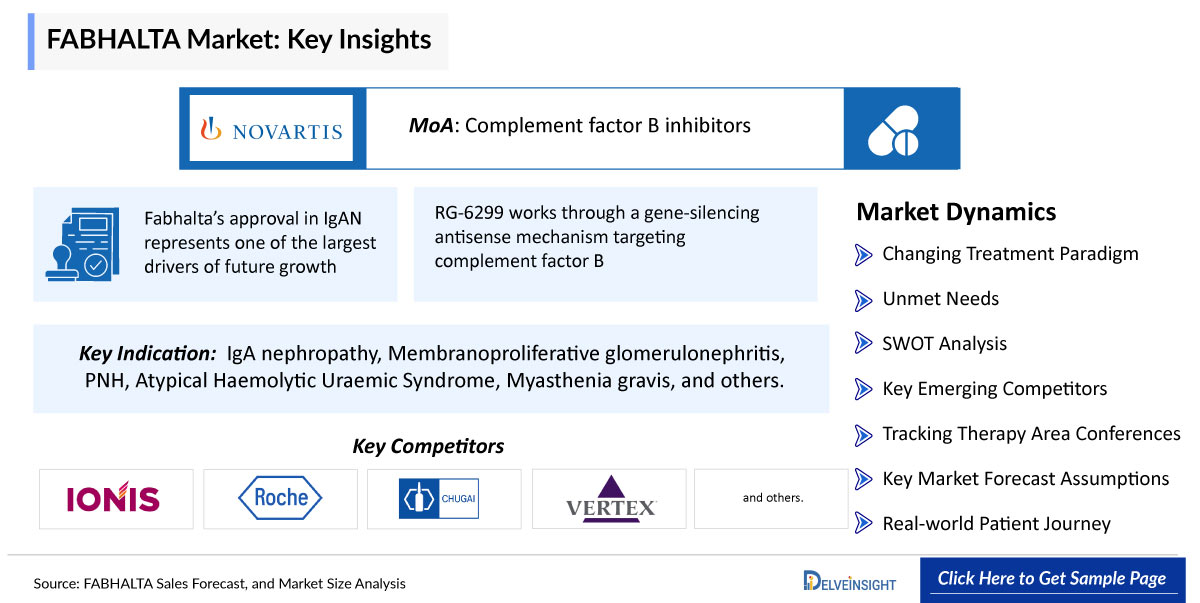
Fabhalta’s approval in IgA nephropathy (IgAN) represents one of the largest drivers of future growth.
- The drug received FDA accelerated approval in 2024 for reduction of proteinuria in IgAN.
- Phase III APPLAUSE-IgAN trial results showed Fabhalta significantly slowed kidney function decline and reduced proteinuria by ~38% versus placebo.
- IgAN is a progressive autoimmune kidney disease where up to 50% of patients may progress to kidney failure within 10–20 years.
Because current therapies are limited, Fabhalta is positioned as a disease-modifying targeted therapy, significantly expanding its addressable patient population.
Expansion Into Additional Rare Kidney Diseases
Novartis is expanding Fabhalta into additional complement-mediated kidney diseases.
One major opportunity is:
- C3 Glomerulopathy (C3G) – a rare disease with no approved therapies historically.
- In the Phase III APPEAR-C3G study, Fabhalta reduced proteinuria by 35.1% vs placebo at six months.
The European Medicines Agency’s CHMP has recommended approval for this indication, which would further broaden the drug’s commercial potential.
Large Addressable Market in Complement-Mediated Diseases
Complement-driven diseases represent a rapidly expanding therapeutic area.
Key opportunity areas for Fabhalta include:
- Paroxysmal nocturnal hemoglobinuria (PNH)
- IgA nephropathy
- C3 glomerulopathy
- Other complement-mediated renal disorders
The IgA nephropathy market alone was valued at ~$1.2 billion in 2024 and is projected to reach ~$2.8 billion by 2033, creating significant revenue opportunities for Fabhalta.
Because Fabhalta targets the **complement pathway—a central disease driver in several conditions—it could potentially expand into additional autoimmune and renal indications.
Strong Early Launch Performance
Fabhalta’s commercial launch is gaining traction.
- Novartis reported $57 million in sales during the early global launch phase in 2024.
- Uptake is supported by strong physician interest due to the oral administration and improved clinical outcomes compared with existing therapies.
FABHALTA Recent Developments
In March 2025, Novartis announced that oral FABHALTA (iptacopan) received US Food and Drug Administration (FDA) approval for the treatment of adults with C3 glomerulopathy (C3G), to reduce proteinuria, making it the first and only treatment approved for this condition.
“FABHALTA Sales Forecast, and Market Size Analysis – 2034” report provides comprehensive insights of FABHALTA for approved indication like IgA nephropathy, Membranoproliferative glomerulonephritis, PNH; as well as potential indications like Atypical Haemolytic Uraemic Syndrome, Myasthenia gravis, Lupus nephritis, Membranous glomerulonephritis, and Vasculitis in the 7MM. A detailed picture of FABHALTA’s existing usage in approved and anticipated entry and performance in potential indications in the 7MM, i.e., the United States, EU4 (Germany, France, Italy, and Spain) and the United Kingdom, and Japan for the study period 2020 –2034 is provided in this report along with a detailed description of the FABHALTA for approved and potential indications. The FABHALTA market report provides insights about FABHALTA’s sales forecast, mechanism of action (MoA), dosage and administration, as well as research and development including regulatory milestones, along with other developmental activities. Further, it also consists of historical and current FABHALTA performance, future market assessments inclusive of the FABHALTA market forecast analysis for approved and potential indications in the 7MM, SWOT, analysts’ views, comprehensive overview of market competitors, and brief about other emerging therapies in respective indications. It also provides analysis of FABHALTA sales forecasts, along with factors driving its market.
FABHALTA Drug Summary
FABHALTA (iptacopan) is an oral complement factor B inhibitor developed by Novartis, indicated for the treatment of adults with paroxysmal nocturnal hemoglobinuria (PNH) as monotherapy to control hemolytic anemia by targeting the alternative complement pathway upstream of C3 and C5, thereby addressing both intravascular and extravascular hemolysis, with clinical data showing hemoglobin improvements, LDH reductions over 60%, and fatigue relief compared to anti-C5 therapies. It is also approved to reduce proteinuria in adults with primary immunoglobulin A nephropathy (IgAN) at risk of rapid progression and in adults with complement 3 glomerulopathy (C3G), often in combination with renin-angiotensin system inhibitors, based on significant proteinuria decreases though continued approval for IgAN may depend on confirmatory kidney function studies. Administered as 200 mg capsules twice daily with food, it carries boxed warnings for serious infections from encapsulated bacteria, requiring prior vaccinations, antibiotic prophylaxis, and enrollment in a REMS program. The report provides FABHALTA’s sales, growth barriers and drivers, post usage and approvals in multiple indications.
Scope of the FABHALTA Market Report
The report provides insights into:
- A comprehensive product overview including the FABHALTA MoA, description, dosage and administration, research and development activities in approved indications like IgA nephropathy, Membranoproliferative glomerulonephritis, PNH; as well as potential indications like Atypical Haemolytic Uraemic Syndrome, Myasthenia gravis, Lupus nephritis, Membranous glomerulonephritis, and Vasculitis.
- Elaborated details on FABHALTA regulatory milestones and other development activities have been provided in FABHALTA market report.
- The report also highlights FABHALTA‘s cost estimates and regional variations, reported and estimated sales performance, research and development activities in approved and potential indications across the United States, Europe, and Japan.
- The FABHALTA market report also covers the patents information, generic entry and impact on cost cut.
- The FABHALTA market report contains current and forecasted FABHALTA sales for approved and potential indications till 2034.
- Comprehensive coverage of the late-stage emerging therapies for respective indications.
- The FABHALTA market report also features the SWOT analysis with analyst views for FABHALTA in approved and potential indications.
Methodology
The FABHALTA market report is built using data and information sourced primarily from internal databases, primary and secondary research and in-house analysis by DelveInsight’s team of industry experts. Information and data from the secondary sources have been obtained from various printable and nonprintable sources like search engines, news websites, global regulatory authorities websites, trade journals, white papers, magazines, books, trade associations, industry associations, industry portals and access to available databases.
FABHALTA Analytical Perspective by DelveInsight
- In-depth FABHALTA Market Assessment
This FABHALTA sales market forecast report provides a detailed market assessment of FABHALTA for approved indication like IgA nephropathy, Membranoproliferative glomerulonephritis, PNH; as well as potential indications like Atypical Haemolytic Uraemic Syndrome, Myasthenia gravis, Lupus nephritis, Membranous glomerulonephritis, and Vasculitis in the seven major markets, i.e., the United States, EU4 (Germany, France, Italy, and Spain) and the United Kingdom, and Japan. This segment of the report provides current and forecasted FABHALTA sales data uptil 2034.
- FABHALTA Clinical Assessment
The FABHALTA market report provides the clinical trials information of FABHALTA for approved and potential indications covering trial interventions, trial conditions, trial status, start and completion dates.
- FABHALTA Competitive Landscape
The report provides Insights on competitors and marketed products within the domain, along with a summary of emerging products and their respective launch dates, posing significant competition in the market.
FABHALTA Market Potential & Revenue Forecast
- Projected market size for the FABHALTA and its key indications
- Estimated FABHALTA sales potential (FABHALTA peak sales forecasts)
- FABHALTA Pricing strategies and reimbursement landscape
FABHALTA Competitive Intelligence
- Number of competing drugs in development (pipeline analysis)
- FABHALTA Market positioning compared to existing treatments
- FABHALTA Strengths & weaknesses relative to competitors
FABHALTA Regulatory & Commercial Milestones
- FABHALTA Key regulatory approvals & expected launch timelines
- Commercial partnerships, licensing deals, and M&A activity
FABHALTA Clinical Differentiation
- FABHALTA Efficacy & safety advantages over existing drugs
- FABHALTA Unique selling points
FABHALTA Market Report Highlights
- In the coming years, the FABHALTA market scenario is set to change due to strong adoption, increased prescriptions and broader uptake in multiple immunological indications; which would expand the size of the market.
- The FABHALTA companies are developing therapies that focus on novel approaches to treat/improve the disease condition, assess challenges, and seek opportunities that could influence FABHALTA’s dominance.
- Other emerging products for IgA nephropathy, Membranoproliferative glomerulonephritis, PNH; as well as potential indications like Atypical Haemolytic Uraemic Syndrome, Myasthenia gravis, Lupus nephritis, Membranous glomerulonephritis, and Vasculitis are expected to give tough market competition to FABHALTA and launch of late-stage emerging therapies in the near future will significantly impact the market.
- A detailed description of regulatory milestones, and developmental activities, provide the current development scenario of FABHALTA in approved and potential indications.
- Analyse FABHALTA cost, pricing trends and market positioning to support strategic decision-making in the immunology landscape.
- Our in-depth analysis of the forecasted FABHALTA sales data uptil 2034 will support the clients in decision-making process regarding their therapeutic portfolio by identifying the overall scenario of FABHALTA in approved and potential indications.
Key Questions
- What is the class of therapy, route of administration and mechanism of action of FABHALTA? How strong is FABHALTA’s clinical and commercial performance?
- What is FABHALTA’s clinical trial status in each individual indications such as IgA nephropathy, Membranoproliferative glomerulonephritis, PNH; as well as potential indications like Atypical Haemolytic Uraemic Syndrome, Myasthenia gravis, Lupus nephritis, Membranous glomerulonephritis, and Vasculitis and study completion date?
- What are the key collaborations, mergers and acquisitions, licensing and other activities related to the FABHALTA Manufacturers?
- What are the key designations that have been granted to FABHALTA for approved and potential indications? How are they going to impact FABHALTA’s penetration in various geographies?
- What is the current and forecasted FABHALTA market scenario for approved and potential indications? What are the key assumptions behind the forecast?
- What are the current and forecasted sales of FABHALTA in the seven major countries, including the United States, Europe (Germany, France, Italy, Spain) and the United Kingdom, and Japan?
- What are the other emerging products available and how are these giving competition to FABHALTA for approved and potential indications?
- Which are the late-stage emerging therapies under development for the treatment of approved and potential indications?
- How cost-effective is FABHALTA? What is the duration of therapy and what are the geographical variations in cost per patient?