
Spinal Cord Stimulators Market Summary
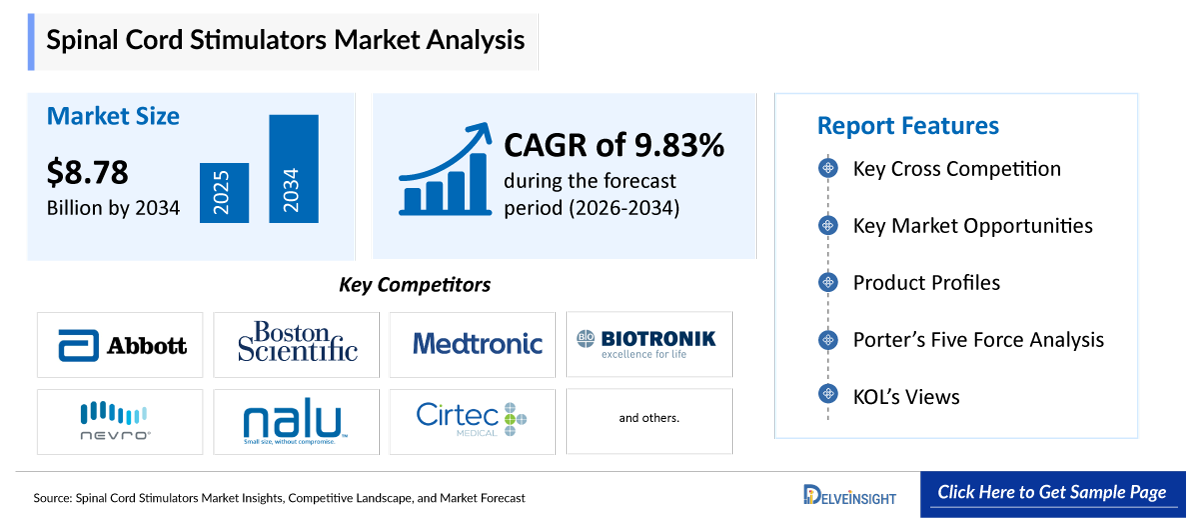
- The global spinal cord stimulators market size was valued at USD 3.78 billion in 2025 and is projected to reach USD 8.78 billion by 2034.
- The market is expected to expand at a CAGR of 9.83% during the forecast period 2026-2034, supported by the rising prevalence of chronic pain, the shift toward non-opioid and minimally invasive pain management, and continuous technological advancement in neurostimulation devices.
- By product type, the rechargeable segment dominated the spinal cord stimulators market with a 68% share in 2025.
- By stimulation technology, the conventional (tonic) segment dominated the spinal cord stimulators market with a 41% share in 2025.
- By application, the failed back surgery syndrome segment dominated the spinal cord stimulators market with a 44% share in 2025.
- By end-user, the hospitals segment dominated the spinal cord stimulators market with a 52% share in 2025.
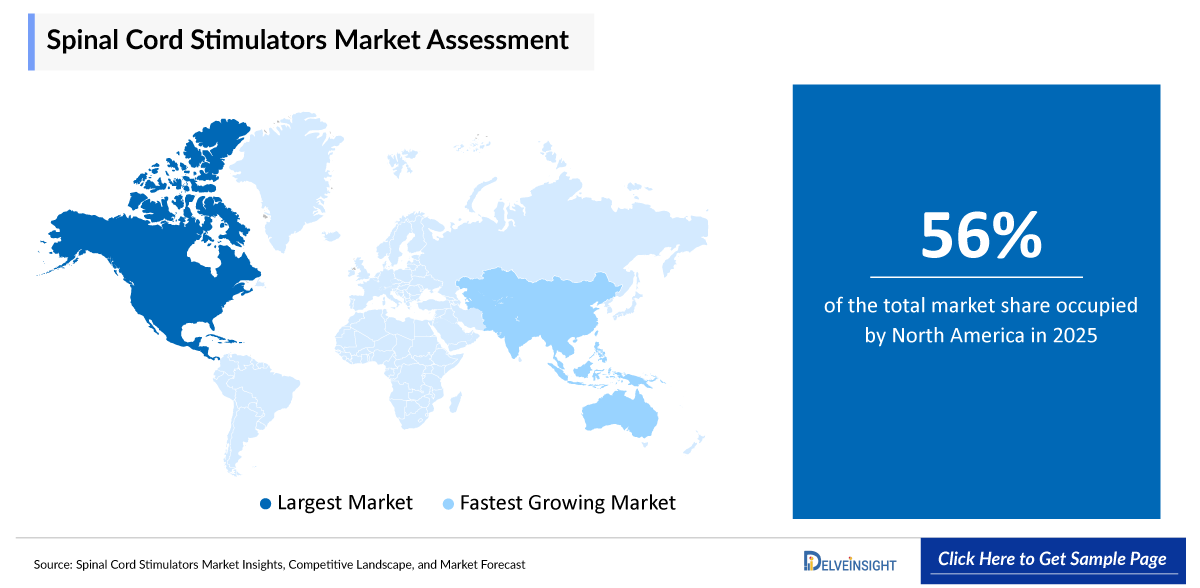
- North America accounted for the largest share of the spinal cord stimulators market at 56% in 2025, while Asia-Pacific is anticipated to register the fastest growth through 2034.
A spinal cord stimulator is an implantable neuromodulation device used to treat chronic, intractable pain by delivering controlled electrical impulses to the spinal cord that interrupt or mask pain signals before they reach the brain. A complete system comprises an implantable pulse generator, which houses the battery and electronics and is placed under the skin, and one or more leads carrying electrode contacts that are positioned in the epidural space over the dorsal columns of the spinal cord, together with an external programmer and patient controller. The market is best understood the way manufacturers organize their portfolios, which is along three intersecting dimensions rather than by battery type alone.
The first is the power source of the pulse generator, which is either rechargeable, allowing a smaller and longer-lived implant, or non-rechargeable and recharge-free, which spares the patient the burden of recharging. The second and most competitively decisive dimension is the stimulation technology, or waveform, which spans conventional low-frequency tonic stimulation, high-frequency 10 kHz stimulation, burst stimulation, and closed-loop stimulation that senses the spinal cord response and adjusts therapy in real time. The third is the anatomical target, encompassing dorsal column spinal cord stimulation and the distinct dorsal root ganglion stimulation used for focal pain. The contemporary market is defined by the shift toward paresthesia-free waveforms, the arrival of closed-loop sensing, the movement of the procedure into outpatient settings, and the positioning of neurostimulation as a non-opioid solution for chronic pain.
Spinal Cord Stimulators Market Key Growth Drivers
- Rising prevalence of chronic pain, with the World Health Organization reporting 619 million cases of lower back pain in 2023 and projecting a rise to 843 million by 2050.
- A very large severe-pain population, with the European Pain Federation estimating that 740 million people globally experience an episode of severe pain, of whom some 20% develop chronic pain.
- A high burden of failed back surgery syndrome, reported by NIH-published research to affect between 10% and 40% of patients following back surgery.
- Growing preference for minimally invasive, drug-free, and reversible neuromodulation over long-term pharmacological therapy and repeat surgery.
- Limitations and risks of opioid therapy, accelerating the shift toward non-opioid alternatives for chronic pain control.
- Technological advancement including rechargeable systems, closed-loop stimulation, high-frequency and burst waveforms, and wireless programming.
- An expanding geriatric population that is more prone to chronic pain, degenerative spine conditions, and nerve-related disorders.
Key Companies in Spinal Cord Stimulators Market
The competitive field is led by a small group of large medical technology companies operating full neuromodulation franchises that span rechargeable and recharge-free pulse generators and multiple proprietary stimulation waveforms, challenged by specialists in high-frequency and closed-loop stimulation. The leading participants in the spinal cord stimulators market include the following:
- Abbott Laboratories
- Boston Scientific Corporation
- Medtronic plc
- Nevro Corp.
- Saluda Medical Pty Ltd.
- Biotronik SE & Co. KG
- Nalu Medical Inc.
- Beijing PINS Medical Co. Ltd.
- Cirtec Medical Corporation
- Greatbatch (Integer Holdings Corporation), and others
For illustrative purposes, only the top 10 companies are listed in the Table of Contents. The report may include analysis and references to additional companies relevant to the market assessment.
Spinal Cord Stimulators Market Size
The following table summarizes the headline market metrics for the global spinal cord stimulators market across the base year and the forecast horizon.
|
Report Metrics |
Details |
|
2025 Market Size |
USD 3.78 billion |
|
2034 Projected Market Size |
USD 8.78 billion |
|
Growth Rate (2026-2034) |
9.83% CAGR |
|
Largest Market |
North America (56% share in 2025) |
|
Fastest Growing Market |
Asia-Pacific |
|
Market Structure |
Moderately Consolidated |
All market values are expressed in USD and represent DelveInsight estimates synthesized from primary and secondary research.
Factors Contributing to the Growth of the Spinal Cord Stimulators Market
Spinal Cord Stimulators Market Drivers
- Rising Prevalence of Chronic Pain and Degenerative Spine Conditions: The foundational driver of the spinal cord stimulators market is the large and rising global burden of chronic pain, which generates the patient population on which the entire category depends. According to the World Health Organization, there were 619 million cases of lower back pain in 2023, a figure projected to rise to 843 million by 2050, and the European Pain Federation estimates that 740 million people globally experience an episode of severe pain at some point in their lives, of whom some 20% develop pain that persists beyond three months and is therefore classified as chronic. Chronic pain conditions such as failed back surgery syndrome, complex regional pain syndrome, neuropathic pain, painful diabetic neuropathy, and degenerative spinal disorders significantly impair quality of life and productivity, and the demand for long-term, effective pain management continues to rise as these conditions become more prevalent. Because spinal cord stimulation offers durable relief for patients whose pain is refractory to medication and who are not candidates for or have failed further surgery, the expanding chronic pain population translates directly into a growing pool of candidates for implantation. The degenerative spine conditions that drive much of this burden, including the sequelae of herniated discs and spinal stenosis, are themselves increasing as population’s age and as rates of spinal surgery rise, reinforcing the durability of the demand. This broad and demographically anchored pain burden makes chronic pain one of the most stable and expanding end markets in medical devices.
- Growing Preference for Minimally Invasive, Non-Opioid Pain Management: A powerful and accelerating driver of the spinal cord stimulators market is the shift in chronic pain management away from long-term pharmacological therapy, and opioids in particular, toward minimally invasive and drug-free neuromodulation. Spinal cord stimulators offer a minimally invasive, reversible alternative to both chronic medication and repeat surgical intervention, delivering pain relief without extensive surgery or prolonged hospitalization, and this profile has made them increasingly attractive to patients and clinicians alike. The driver is reinforced powerfully by the opioid crisis and the growing awareness of the adverse effects, dependency risks, and tightening regulatory restrictions associated with opioid-based pain management, which have created strong clinical and policy pressure to adopt non-opioid solutions for chronic pain. Spinal cord stimulation is increasingly positioned, and increasingly supported by clinical guidelines and payers, as a safer long-term alternative that can reduce or eliminate opioid use, and studies of high-frequency therapy have demonstrated the ability to reduce or eliminate opioids in a majority of treated patients. As health systems actively seek to curb opioid prescribing and as the evidence base for neuromodulation as an opioid-sparing therapy strengthens, the positioning of spinal cord stimulators as a non-opioid solution is converting a growing share of the chronic pain population into candidates for implantation.
- Technological Advancement in Neurostimulation: Continuous technological advancement in neurostimulation is a central driver of the spinal cord stimulators market, improving efficacy, patient comfort, and the breadth of the treatable population, and it is the principal axis of competition among manufacturers. The most consequential advances concern the stimulation waveform. Conventional low-frequency tonic stimulation, which relies on replacing the sensation of pain with a tingling paresthesia, has been progressively complemented and in many cases displaced by paresthesia-free approaches, including high-frequency 10 kHz stimulation, which delivers relief without paresthesia and has secured specific indications for painful diabetic neuropathy and non-surgical refractory back pain, and burst stimulation, which mimics the natural firing patterns of the brain and modulates both the sensory and emotional dimensions of pain. The most recent frontier is closed-loop stimulation, which measures the evoked compound action potential generated by the spinal cord in response to each pulse and adjusts stimulation in real time to keep therapy within the therapeutic window as the patient moves. In parallel, rechargeable systems have been miniaturized, recharge-free devices extended in longevity, and both equipped with full-body magnetic resonance conditional labeling, Bluetooth wireless programming, and remote monitoring that allows therapy adjustment without in-person visits. Because these advances expand the eligible patient pool, improve durable outcomes, and differentiate competing systems, technological advancement is among the most direct determinants of market growth.
- Rising Product Development and Regulatory Approval: A sustained cadence of product development and regulatory approval is directly expanding the spinal cord stimulators market by broadening the range of waveforms, indications, and form factors available and by intensifying competition among manufacturers. Because the field competes principally on stimulation technology and device design, each new clearance either introduces a differentiating waveform or platform or extends an existing system into a new indication, and the pace of approval has been rapid. Recent activity illustrates the breadth of this dynamic, including the approval of the first closed-loop rechargeable systems that sense and adapt to the spinal cord response, the approval of the smallest implantable rechargeable spinal cord stimulators, the expansion of high-frequency therapy labeling into painful diabetic neuropathy and non-surgical refractory back pain, the extension of full-body magnetic resonance conditional labeling across portfolios, and the entry of new systems from both established and emerging manufacturers. Favorable government regulation has played a crucial role in accelerating the commercialization and launch of advanced devices, and each approval that adds a differentiated therapy or a new indication expands the addressable population and the value captured per implant. Because the installed base of implanting physicians and centers grows only gradually, growth comes disproportionately from raising the sophistication, indication breadth, and value of the systems implanted, which makes the pace of product development a principal determinant of market expansion.
- Expanding Geriatric Population: Demographic aging is a structural driver of the spinal cord stimulators market, because the chronic pain and degenerative spine conditions that neurostimulation treats are strongly concentrated in older adults and the population at greatest risk is growing faster than the population as a whole. The prevalence of chronic low back pain, neuropathic pain, spinal stenosis, and the degenerative disc disease that underlies much of the treated burden rises markedly with age, and older patients are also more likely to have exhausted conservative and surgical options and to be poor candidates for further surgery, making them well suited to a minimally invasive, reversible therapy. Older patients often specifically seek durable pain relief that minimizes the systemic side effects and drug interactions associated with chronic analgesic and opioid use, a preference that favors neuromodulation, and the same population is disproportionately affected by painful diabetic neuropathy, a large and growing indication for high-frequency stimulation. As the global population aged 65 and above expands rapidly across developed and developing markets alike, the pool of patients presenting with refractory chronic pain grows correspondingly, and because these patients increasingly expect active, durable treatment rather than resignation to chronic pain, demand for spinal cord stimulation grows with them. Because aging is a slow, predictable, and effectively irreversible trend, it provides a stable foundation for long-term demand that is largely independent of economic cycles.
- Improving Reimbursement and Healthcare Infrastructure: Improving reimbursement coverage and the strengthening of healthcare infrastructure are important drivers of the spinal cord stimulators market, because the therapy is a high-cost implantable procedure whose adoption depends heavily on the willingness of payers to reimburse it and on the availability of the specialized centers and trained physicians required to deliver it. In the developed markets that account for the majority of current volume, reimbursement coverage for spinal cord stimulation has improved as the clinical evidence base has strengthened and as payers have recognized its value as an opioid-sparing and surgery-sparing therapy, supporting higher procedure volumes. The standard pathway of a temporary trial period followed by permanent implantation only in responders, which is built into clinical practice and reimbursement, further supports payer confidence by ensuring that permanent devices are placed only in patients who have demonstrated benefit. In emerging economies, the gradual expansion and modernization of healthcare infrastructure, the growth in the number of pain-management and neurosurgical centers, and rising healthcare investment are extending access to neuromodulation therapies to populations that previously lacked it, opening large new sources of demand. Because access to this therapy is gated as much by reimbursement and infrastructure as by clinical need, improvements on both fronts directly convert latent demand into procedures, making them meaningful and durable contributors to market growth.
- Increasing Clinical Evidence and Physician Awareness: The growing body of clinical evidence supporting spinal cord stimulation, together with rising physician awareness and training, is a significant driver that underpins the adoption of the therapy and the shift toward its newer modalities. Spinal cord stimulation has been the subject of an expanding set of randomized controlled trials, long-term outcome studies, and real-world evidence that have progressively strengthened confidence in its durability and its superiority to conventional medical management for appropriate patients, exemplified by the pivotal trials establishing high-frequency therapy for back and leg pain and for painful diabetic neuropathy and by the multi-year evidence supporting closed-loop stimulation. This accumulation of evidence boosts physician confidence, informs the clinical guidelines and payer policies that govern access, and supports the movement of the therapy earlier in the treatment pathway. It is reinforced by enhanced training programs and awareness initiatives that expand the number of physicians across pain-management, neurosurgical, and anesthesiology settings who are able to implant and manage these devices, addressing the workforce constraint that limits diffusion of the therapy. Public awareness campaigns, including designated pain-awareness initiatives that educate patients about non-opioid treatment options, further increase presentation and demand. Because evidence, guidelines, and trained physicians together determine how widely and how appropriately the therapy is adopted, their continued growth is a durable driver of market expansion.
Spinal Cord Stimulators Market Restraints
Despite a strong and expanding demand base, the spinal cord stimulators market faces material constraints that temper the pace of adoption. The most significant is the high cost of the device and the implantation procedure. A spinal cord stimulation system represents a substantial capital and per-procedure expense, encompassing the pulse generator, leads, the trial and permanent implantation procedures, and long-term follow-up and programming, and this cost limits access particularly in cost-sensitive and developing markets and exposes the therapy to the reimbursement decisions of payers, who may restrict coverage, require extensive prior authorization, or mandate that conservative options be exhausted first. The second constraint is the risk of complications associated with these technologically advanced implantable devices. Spinal cord stimulation carries risks including lead migration, which is the most common device-related complication and can require revision surgery, as well as lead fracture, infection, unwanted stimulation, loss of therapeutic effect over time, and, with rechargeable systems, the burden of recharging, while the sophistication of newer closed-loop and high-frequency systems introduces its own complexity in programming and management. These complications can necessitate revision or explantation, increase the total cost of care, and create caution among physicians and patients. Additional constraints include the significant proportion of patients who do not achieve sufficient relief during the trial period and therefore do not proceed to permanent implantation, the variability of long-term outcomes and the phenomenon of diminishing efficacy in some patients, the shortage of trained implanting physicians that limits diffusion beyond specialized centers, and the stringent and lengthy regulatory pathways that raise the barrier to introducing new systems. Trade policy and the concentration of the market among a few large manufacturers add further pressure on pricing and supply. Together, these clinical, economic, and structural factors ensure that growth, while robust, proceeds unevenly across geographies and care settings.
Spinal Cord Stimulators Market Segment Analysis
The global spinal cord stimulators market is segmented by product type into rechargeable and non-rechargeable (recharge-free) systems; by stimulation technology into conventional (tonic), high-frequency (10 kHz), burst, and closed-loop stimulation; by application into failed back surgery syndrome, degenerative disc disease, complex regional pain syndrome, painful diabetic neuropathy, and others; by end-user into hospitals, ambulatory surgical centers, and pain and specialty clinics; and by geography into North America, Europe, Asia-Pacific, and the Rest of the World.
By Product Type
Dominant Subsegment: Rechargeable.
The rechargeable category is expected to dominate the market.
Dominant: Rechargeable ~ 68%
The rechargeable segment accounted for a 68% share of the spinal cord stimulators market in 2025. Rechargeable spinal cord stimulators dominate the product-type structure because their rechargeable battery permits a substantially smaller implant and a much longer functional lifespan than a primary-cell device, avoiding the replacement surgeries that a non-rechargeable generator eventually requires and delivering significant lifetime cost savings. The miniaturization enabled by rechargeable technology reduces the invasiveness of implantation, enhances patient comfort, and supports the energy demands of the advanced high-frequency and closed-loop waveforms that define contemporary therapy, and rechargeable systems are typically paired with remote monitoring and wireless programming that allow therapy adjustment without in-person visits. These attributes have made rechargeable systems the mainstay of the market and the platform on which manufacturers introduce their most advanced features. Non-rechargeable, or recharge-free, systems constitute the second product-type segment and an important and growing one, because a meaningful share of patients, particularly older patients and those who find the discipline of regular recharging burdensome, prefer a device that requires no recharging even at the cost of eventual replacement, and manufacturers have responded with recharge-free systems whose longevity has been extended to many years through low-energy waveforms such as burst microdosing. The competitive dynamic between the two is therefore defined less by a simple contest than by the matching of power source to patient preference and waveform. Rechargeable systems are expected to retain their leading share throughout the forecast period, even as recharge-free devices grow on the strength of low-energy therapies.
By Stimulation Technology
Dominant Subsegment: Conventional (Tonic).
The conventional tonic category is expected to dominate the market in the base year.
Dominant: Conventional (Tonic) ~ 41%
The conventional (tonic) segment accounted for a 41% share of the spinal cord stimulators market in 2025. Conventional low-frequency tonic stimulation dominates the technology structure in the base year because it is the original and most widely installed spinal cord stimulation modality, supported by decades of clinical use, the broadest physician familiarity, and the largest installed base of implanted systems and compatible leads. Tonic stimulation relieves pain by delivering low-frequency pulses that replace the sensation of pain with a tingling paresthesia over the painful area, and it remains effective, well understood, and widely reimbursed, which sustains its leading share even as newer waveforms gain ground. The decisive dynamic in this axis, however, is the rapid rise of the paresthesia-free and adaptive waveforms that are reshaping the market. High-frequency 10 kHz stimulation delivers relief without paresthesia and has secured differentiated indications for painful diabetic neuropathy and non-surgical refractory back pain; burst stimulation mimics the natural firing patterns of the brain and addresses both the sensory and emotional dimensions of pain at low energy; and closed-loop stimulation senses the evoked compound action potential of the spinal cord and adjusts each pulse in real time to hold therapy within the therapeutic window. These advanced waveforms are growing far faster than conventional stimulation and are progressively displacing it in new implants, so the base-year dominance of tonic stimulation coexists with a decisive shift in the mix of newly implanted systems toward high-frequency, burst, and closed-loop therapy. The technology structure of the market is therefore expected to change more substantially than any other segmentation dimension over the forecast period.
By Application
Dominant Subsegment: Failed Back Surgery Syndrome.
The failed back surgery syndrome category is expected to dominate the market.
Dominant: Failed Back Surgery Syndrome ~ 44%
The failed back surgery syndrome segment accounted for a 44% share of the spinal cord stimulators market in 2025. Failed back surgery syndrome dominates the application structure because it is the classic and most established indication for spinal cord stimulation and accounts for the largest share of implantation. The syndrome occurs when patients continue to experience chronic back or leg pain after one or more spinal surgeries, and NIH-published research reports that it affects between 10% and 40% of patients following back surgery, a proportion that translates into a very large candidate population as the global volume of spinal surgery for herniated discs, spinal stenosis, and degenerative conditions continues to rise. Because repeated surgery in these patients carries higher risk and frequently fails to relieve pain, spinal cord stimulation has emerged as a preferred, minimally invasive, and durable alternative, and the strong clinical evidence supporting neurostimulation in this population reinforces its position as the leading indication. Degenerative disc disease constitutes a second major application, encompassing the chronic axial and radicular pain of spinal degeneration, and complex regional pain syndrome represents an established indication particularly associated with dorsal root ganglion stimulation for focal limb pain. Painful diabetic neuropathy has emerged as one of the fastest-growing applications, driven by the diabetes epidemic and by the specific approval of high-frequency therapy for the indication, and other neuropathic and chronic pain conditions round out the segment. Failed back surgery syndrome is expected to retain its leading share throughout the forecast period, even as painful diabetic neuropathy grows fastest.
By End-User
Dominant Subsegment: Hospitals.
The hospitals category is expected to dominate the market.
Dominant: Hospitals ~ 52%
The hospitals segment accounted for a 52% share of the spinal cord stimulators market in 2025. Hospitals dominate the end-user structure because spinal cord stimulator implantation, while minimally invasive, is a surgical implant procedure that has historically been performed in the hospital setting, where the specialized infrastructure, imaging, sterile operative environment, and multidisciplinary teams of pain physicians, neurosurgeons, and anesthesiologists required for both the trial and permanent implantation are available. Hospitals possess the capital capacity to invest in the imaging and surgical equipment these procedures require, they manage the more complex patients and those with significant comorbidity, and they serve as the principal sites for the physician training and clinical research that advance the therapy, all of which concentrate procedural volume in the inpatient and hospital-outpatient setting. Ambulatory surgical centers form the fastest-growing end-user segment, as the minimally invasive nature of the procedure, improvements in technique, and favorable reimbursement for the outpatient setting have supported a marked migration of both trial and permanent implantation into dedicated ambulatory facilities, which offer efficiency, lower cost, and convenience. Pain and specialty clinics play an increasingly important role in patient selection, trial procedures, device programming, and long-term management, reflecting the central position of interventional pain specialists in the therapy. Hospitals are expected to retain their leading share throughout the forecast period, although ambulatory surgical centers will capture a rising proportion of procedures as the outpatient migration continues.
Spinal Cord Stimulators Market Region Analysis
Dominant Region: North America
Dominant: North America ~ 56% (Largest)
North America accounted for a 56% share of the global spinal cord stimulators market in 2025. The region leads the global market, driven by a sharp increase in chronic pain cases, growing government efforts including public awareness programs, intensive product development and innovation by the leading manufacturers, and favorable reimbursement policies that enhance patient access. According to the Centers for Disease Control and Prevention, 51.6 million United States adults were suffering from chronic pain and 17.1 million had high-impact chronic pain that substantially restricts daily activity, and the Public Health Agency of Canada reports that 8 million individuals live with chronic pain in Canada, a large and rising burden that necessitates advanced pain management and drives demand for spinal cord stimulation. Government initiatives such as United States awareness programs addressing chronic pain, which focus on education, prevention, and early detection, and the designation of September as Pain Awareness Month, in which the National Institutes of Health and other organizations promote awareness of pain management, further support the market. The United States represents the largest market worldwide, home to the great majority of the leading manufacturers and the reference market for regulatory approval of new waveforms and systems, and rising product launches and commercialization agreements continue to boost growth, exemplified by the United States launch of the first closed-loop sensing system. High healthcare expenditure, established interventional pain practice, and strong reimbursement reinforce North American leadership. The region is expected to retain its dominant position throughout the forecast period.
Fastest Growing Region: Asia-Pacific
Asia-Pacific is projected to register the fastest compound annual growth rate in the spinal cord stimulators market through 2034. The region is emerging as the principal growth engine of the market, propelled by an enormous and rapidly aging population, a rising burden of chronic pain and degenerative spine conditions, increasing healthcare expenditure, and the expansion of pain-management and neurosurgical capacity. The diabetes epidemic across Asia-Pacific is producing a large and growing population with painful diabetic neuropathy, a fast-growing indication for high-frequency spinal cord stimulation, while urbanization, sedentary lifestyles, and rising rates of spinal surgery are increasing the burden of chronic back and neuropathic pain. Improving healthcare infrastructure, expanding hospital and specialty-clinic networks, and growing access to advanced neuromodulation technologies are facilitating adoption, and government investment in healthcare and the gradual improvement of reimbursement are extending access to therapies that were previously unavailable. Multinational manufacturers are expanding their regional presence through partnerships with local hospitals and distributors, while domestic manufacturers, most notably in China, are developing cost-effective neurostimulation systems tailored to price-sensitive markets. China contributes the largest incremental volume, supported by a vast population, a growing domestic industry, and expanding surgical capacity; Japan combines an aged population with advanced clinical practice; and India represents a substantial long-term opportunity as access broadens. Regional growth is expected to exceed the global average across every segment, making Asia-Pacific the principal source of incremental demand over the forecast period.
Spinal Cord Stimulators Regional Commentary
North America
North America leads on value, innovation, and regulatory precedence, holding a 56% share in 2025. The Centers for Disease Control and Prevention report 51.6 million United States adults with chronic pain and 17.1 million with high-impact chronic pain, and the Public Health Agency of Canada reports 8 million Canadians with chronic pain. The United States is the largest market worldwide, home to most of the leading manufacturers and the reference market for new waveform and system approvals, supported by strong reimbursement, established interventional pain practice, and government awareness initiatives including Pain Awareness Month. Near-term dynamics are shaped by the shift to closed-loop and high-frequency waveforms, the opioid-sparing positioning of the therapy, and the migration of procedures into ambulatory settings.
Europe
Europe is a large and innovation-oriented market, supported by a high chronic pain burden, aging populations, well-established and often publicly funded pain-management systems, and early adoption of advanced neuromodulation. The European Pain Federation estimates that 740 million people globally experience severe pain, with a substantial share in Europe developing chronic pain, and the region is frequently an early market for new systems, exemplified by the CE Mark approval of the first closed-loop rechargeable system and by European launches of advanced waveform platforms. Germany, the United Kingdom, France, and Italy account for the highest volumes, supported by reimbursement for neuromodulation, while the European Union Medical Device Regulation has raised the evidentiary burden for new approvals and heterogeneous national reimbursement limits uniform access
Asia-Pacific
Asia-Pacific is the fastest-growing region, propelled by an enormous aging population, a rising burden of chronic pain and degenerative spine conditions, a large and growing painful diabetic neuropathy population, and expanding pain-management capacity. Improving healthcare infrastructure, growing access to advanced neuromodulation, and government investment are facilitating adoption, and domestic manufacturers, most notably in China, are developing cost-effective systems for price-sensitive markets. China contributes the largest incremental volume and a growing domestic industry, Japan combines deep aging with advanced practice, and India offers a substantial long-term opportunity as access broadens. Growth exceeds the global average across every segment.
Rest of World
The Rest of the World comprises the Middle East, Africa, and South America. Access is highly stratified. The Gulf Cooperation Council states and the larger South American markets, particularly Brazil, have invested in pain-management and neurosurgical capacity and increasingly offer advanced neuromodulation, representing growing markets, while much of Africa lacks the specialized centers, trained implanting physicians, and reimbursement required, so a large share of chronic pain is never treated with neurostimulation. The high cost of the therapy and limited reimbursement constrain access in developing countries. Regional growth will be driven by investment in pain-management infrastructure, rising awareness, government health initiatives, and lower-cost systems from regional and Asian manufacturers.
Spinal Cord Stimulators Market Competitive Landscape
The global spinal cord stimulators market is classified as Moderately Consolidated. A small group of large medical technology companies dominates the market through comprehensive neuromodulation portfolios, proprietary stimulation waveforms, strong physician relationships, global distribution, and continuous research and development, while a competitive tier of focused innovators competes on differentiated waveforms and miniaturized form factors. Competition centers on the stimulation technology, the power source and longevity of the pulse generator, magnetic resonance conditionality, and the digital ecosystem, and strategic launches, clinical evidence, and acquisitions intensify rivalry.
The competitive landscape is evaluated across the following dimensions:
- Market concentration: Moderately consolidated, with a small group of large medical technology companies holding the majority of global revenue through full neuromodulation portfolios, alongside a growing tier of high-frequency, closed-loop, and miniaturized-system specialists.
- Leading players: Abbott, Boston Scientific, and Medtronic lead the market with comprehensive portfolios spanning multiple proprietary waveforms, Nevro leads in high-frequency 10 kHz therapy, and Saluda leads in closed-loop evoked-compound-action-potential sensing, with Biotronik, Nalu Medical, and Beijing PINS contesting defined segments.
- Geographic reach: The leading participants maintain global commercial and physician-training organizations, while regional manufacturers such as Beijing PINS leverage cost advantages to serve large domestic and developing markets.
- Product portfolio strength: Competitive advantage rests on offering a breadth of proprietary waveforms across both rechargeable and recharge-free platforms with full-body magnetic resonance conditionality, since physicians increasingly match waveform and power source to the individual pain phenotype and patient lifestyle.
- Pipeline strength: Development is concentrated in closed-loop and sensing-enabled stimulation, next-generation high-frequency and burst waveforms, miniaturized and leadless or wireless systems, and expanded indications such as painful diabetic neuropathy and non-surgical refractory back pain.
- Strategic partnerships: Collaboration spans physician education and training, integration with digital-health and remote-monitoring platforms, and clinical-research alliances validating new waveforms and indications.
- M&A activity: Acquisition has shaped the field, including the acquisition of Nevro by a global investment firm and the earlier consolidation of neuromodulation assets by the diversified leaders, alongside investment in closed-loop and miniaturized-system innovators.
- Innovation focus: Innovation is shifting toward paresthesia-free and adaptive closed-loop stimulation, device miniaturization, the opioid-sparing positioning of the therapy, and digital ecosystems for remote programming and outcome tracking.
- Regulatory standing: United States premarket approval and European Union Medical Device Regulation certification are decisive competitive credentials, and the sequence of waveform and indication approvals has become a principal axis of competition among the leaders.
Spinal Cord Stimulators Market Recent Developmental Activities
- In August 2023, Medtronic plc received CE Mark approval for the Inceptiv closed-loop rechargeable spinal cord stimulator, the first Medtronic device to incorporate closed-loop sensing that continuously measures individual biological signals and dynamically adjusts stimulation in real time to keep therapy synchronized with the patient daily activity. Strategic significance: the entry of the largest neuromodulation company into closed-loop sensing validated the modality as the next competitive frontier and intensified the contest with the pioneer of evoked-compound-action-potential-controlled therapy.
- In December 2022, Abbott Laboratories received U.S. Food and Drug Administration approval for the Eterna spinal cord stimulation system, recognized as the smallest implantable rechargeable spinal cord stimulator available for the treatment of chronic pain. Strategic significance: miniaturization of the rechargeable pulse generator reduced the invasiveness of implantation and improved patient comfort, addressing a key barrier to adoption and reinforcing the strategic importance of device size alongside waveform in the competitive contest.
- In December 2022, Saluda Medical Pty Ltd. launched the Evoke System, described as the first and only closed-loop system measuring the evoked compound action potential of the spinal cord available in the United States, which senses the spinal cord response to each pulse and adjusts stimulation in real time to hold therapy within the therapeutic window. Strategic significance: the introduction of true closed-loop sensing established a new performance benchmark supported by multi-year randomized evidence and forced the established manufacturers to accelerate their own sensing-enabled programs.
- In December 2025, Boston Scientific Corporation conducted a study to assess the effectiveness of FAST, a fast-acting sub-perception paresthesia-free therapy, together with additional stimulation options delivered through its WaveWriter spinal cord stimulation systems in patients with chronic pain. Strategic significance: the continued clinical development of fast-acting sub-perception therapy reinforced the strategic emphasis on paresthesia-free waveforms delivered from a multi-waveform platform, differentiating the portfolio through the breadth of therapies available on a single system.
- In November 2025, the TriCity Research Center announced a clinical study assessing the efficacy and feasibility of BurstDR spinal cord stimulation using the Abbott Proclaim XR and Eterna systems in patients with painful diabetic neuropathy, with responders achieving at least a 50% reduction in pain proceeding to permanent implantation and outcomes evaluated over a six-month follow-up in a rural population. Strategic significance: the study reflected the strategic expansion of neuromodulation into painful diabetic neuropathy, one of the fastest-growing indications, and the effort to extend advanced therapy to underserved rural populations.
- In 2024 and 2025, Nevro Corp. continued to advance its high-frequency 10 kHz therapy through its HFX platform and HFX iQ system, supported by expanded labeling for painful diabetic neuropathy and non-surgical refractory back pain and by consensus guidelines endorsing 10 kHz therapy for refractory painful diabetic neuropathy. Strategic significance: the accumulation of differentiated indications and guideline support for 10 kHz therapy defended the position of the high-frequency pioneer against the broadening waveform portfolios of the larger competitors and anchored its leadership in paresthesia-free stimulation.
- In 2024, Nevro Corp. entered into an agreement to be acquired by a global investment firm, consolidating the high-frequency specialist within a larger platform. Strategic significance: the transaction reflected the competitive and financial pressure on focused neuromodulation specialists competing against diversified leaders with broad waveform portfolios, and it signaled continued consolidation in a market where scale, portfolio breadth, and clinical evidence increasingly determine competitive position.
- In 2024 and 2025, Abbott Laboratories expanded the labeling and evidence base for its BurstDR stimulation and Proclaim recharge-free portfolio, including expanded magnetic resonance conditional labeling and data supporting lower-energy burst microdosing that extends device longevity. Strategic significance: strengthening the evidence and magnetic resonance compatibility of a recharge-free burst platform reinforced the strategy of pairing a differentiated low-energy waveform with a long-lived recharge-free device, addressing the substantial patient segment that prefers to avoid recharging.
- In 2024 and 2025, Boston Scientific Corporation advanced its WaveWriter Alpha portfolio, which unifies rechargeable and recharge-free pulse generators with combination therapy and waveform automation and full-body magnetic resonance conditional access, supported by its Cognita digital solutions suite. Strategic significance: the emphasis on a unified multi-waveform platform with combination therapy and digital support reflected a strategy of competing on breadth and personalization, allowing physicians to combine and automate waveforms for the individual patient.
- In 2023 and 2024, Biotronik SE & Co. KG received U.S. Food and Drug Administration approval for its Prospera spinal cord stimulation system, featuring passive-recharge burst stimulation and continuous objective remote monitoring. Strategic significance: the entry of an established cardiac-rhythm manufacturer into spinal cord stimulation with a differentiated remote-monitoring and burst platform intensified competition and reflected the attraction of the high-growth neuromodulation market to adjacent implantable-device companies.
- In 2024 and 2025, Nalu Medical Inc. advanced its micro implantable pulse generator platform for spinal cord and peripheral nerve stimulation, offering a miniaturized device powered by a wearable external component. Strategic significance: the miniaturized, externally powered architecture represented an alternative design philosophy that reduces implant size dramatically, and it exemplified the wave of focused innovators pursuing form-factor differentiation against the incumbent rechargeable and recharge-free systems.
- In 2024 and 2025, the leading manufacturers expanded closed-loop and sensing-enabled programs and pursued expanded indications and real-world evidence across painful diabetic neuropathy, non-surgical refractory back pain, and other neuropathic conditions, alongside continued device miniaturization and digital-ecosystem development. Strategic significance: the convergence of the leaders on closed-loop sensing, indication expansion, and miniaturization confirmed these as the defining axes of competition, and it signaled a market shifting decisively from fixed-output tonic stimulation toward adaptive, evidence-backed, and personalized neuromodulation.
Spinal Cord Stimulators Market Segmentation
- Spinal Cord Stimulators Market Assessment by Product Type
- Rechargeable Systems
- Non-Rechargeable (Recharge-Free) Systems
- Spinal Cord Stimulators Market Assessment by Stimulation Technology
- Conventional (Tonic) Stimulation
- High-Frequency (10 kHz) Stimulation
- Burst Stimulation
- Closed-Loop (Sensing) Stimulation
- Spinal Cord Stimulators Market Assessment by Anatomical Target
- Dorsal Column Spinal Cord Stimulation (SCS)
- Dorsal Root Ganglion (DRG) Stimulation
- Spinal Cord Stimulators Market Assessment by Application
- Failed Back Surgery Syndrome (FBSS)
- Degenerative Disc Disease (DDD)
- Complex Regional Pain Syndrome (CRPS)
- Painful Diabetic Neuropathy (PDN)
- Others
- Spinal Cord Stimulators Market Assessment by End-User
- Hospitals
- Ambulatory Surgical Centers
- Pain and Specialty Clinics
Spinal Cord Stimulators Market Assessment by Geography
- North America Spinal Cord Stimulators Market Assessment
- United States Spinal Cord Stimulators Market Size in USD million (2023-2034)
- Canada Spinal Cord Stimulators Market Size in USD million (2023-2034)
- Mexico Spinal Cord Stimulators Market Size in USD million (2023-2034)
- Europe Spinal Cord Stimulators Market Assessment
- France Spinal Cord Stimulators Market Size in USD million (2023-2034)
- Germany Spinal Cord Stimulators Market Size in USD million (2023-2034)
- United Kingdom Spinal Cord Stimulators Market Size in USD million (2023-2034)
- Italy Spinal Cord Stimulators Market Size in USD million (2023-2034)
- Spain Spinal Cord Stimulators Market Size in USD million (2023-2034)
- Rest of Europe Spinal Cord Stimulators Market Size in USD million (2023-2034)
- Asia-Pacific Spinal Cord Stimulators Market Assessment
- China Spinal Cord Stimulators Market Size in USD million (2023-2034)
- Japan Spinal Cord Stimulators Market Size in USD million (2023-2034)
- India Spinal Cord Stimulators Market Size in USD million (2023-2034)
- Australia Spinal Cord Stimulators Market Size in USD million (2023-2034)
- South Korea Spinal Cord Stimulators Market Size in USD million (2023-2034)
- Rest of Asia-Pacific Spinal Cord Stimulators Market Size in USD million (2023-2034)
- Rest of the World Spinal Cord Stimulators Market Assessment
- Middle East Spinal Cord Stimulators Market Size in USD million (2023-2034)
- Africa Spinal Cord Stimulators Market Size in USD million (2023-2034)
- South America Spinal Cord Stimulators Market Size in USD million (2023-2034)
Spinal Cord Stimulators Market Recent Industry Trends and Milestones (2023-2026):
|
Category |
Key Developments |
|
Spinal Cord Stimulators Market Product Approval |
The 2023 to 2026 period was defined by the arrival of closed-loop sensing and continued waveform and form-factor innovation. Medtronic secured CE Mark for its Inceptiv closed-loop rechargeable system in August 2023, following the United States launch of the Saluda Evoke closed-loop system, the first to measure the evoked compound action potential, in December 2022. Abbott obtained approval for the Eterna system, the smallest rechargeable stimulator, in December 2022 and subsequently expanded magnetic resonance labeling for its Proclaim and Eterna platforms. Nevro expanded high-frequency 10 kHz labeling into painful diabetic neuropathy and non-surgical refractory back pain, and Biotronik received United States approval for its Prospera system with passive-recharge burst stimulation and remote monitoring. These approvals concentrated competition in closed-loop, high-frequency, and miniaturized systems. |
|
Spinal Cord Stimulators Market Product Expansion |
Product expansion advanced along three axes. The first is stimulation technology, as the field moved decisively beyond conventional tonic stimulation toward paresthesia-free high-frequency and burst waveforms and, most consequentially, toward closed-loop stimulation that senses and adapts to the spinal cord response in real time. The second is power source and form factor, as manufacturers extended both rechargeable systems, miniaturized to the smallest sizes yet achieved, and recharge-free systems, whose longevity was extended through low-energy waveforms such as burst microdosing, and as new architectures including externally powered micro implants emerged. The third is indication breadth, as high-frequency therapy secured differentiated labeling for painful diabetic neuropathy and non-surgical refractory back pain, expanding the addressable population. Full-body magnetic resonance conditionality, Bluetooth programming, and remote monitoring were extended across portfolios. |
|
Spinal Cord Stimulators Market Investment |
Investment was shaped by the strategic contest over closed-loop sensing and by consolidation. The established leaders invested heavily in sensing-enabled and next-generation waveform platforms and in device miniaturization, while the acquisition of the high-frequency pioneer Nevro by a global investment firm reflected the financial pressure on focused specialists competing against diversified portfolios. Venture and strategic capital supported innovators in closed-loop stimulation, miniaturized and externally powered micro implants, and wireless and leadless architectures, as well as companies pursuing expanded indications and digital-health integration. Investment also flowed into the real-world evidence and health-economic studies required to secure reimbursement and guideline support, reflecting the central role of clinical evidence in a market where payers and guidelines gate access. The attraction of the high-growth neuromodulation market drew adjacent implantable-device manufacturers, including established cardiac-rhythm companies, into spinal cord stimulation. |
|
Company Strategy |
The unifying strategic theme is the shift from fixed-output tonic stimulation toward adaptive, personalized, and evidence-backed neuromodulation. Abbott is pairing its proprietary BurstDR waveform with recharge-free and miniaturized rechargeable platforms and expanding into painful diabetic neuropathy and dorsal root ganglion stimulation. Boston Scientific is competing on a unified multi-waveform platform with combination therapy, waveform automation, and a digital ecosystem. Medtronic is advancing closed-loop sensing through Inceptiv alongside its adaptive and recharge-free systems. Nevro is defending its high-frequency 10 kHz leadership through differentiated indications and guideline support, and Saluda is leading in evoked-compound-action-potential closed-loop sensing. Biotronik, Nalu Medical, and Beijing PINS pursue differentiated positions in remote monitoring, miniaturization, and cost-effective regional systems respectively. |
|
Emerging Technologies |
The defining emerging technology is closed-loop stimulation, which senses the evoked compound action potential generated by the spinal cord in response to each pulse and adjusts stimulation in real time to hold therapy within the therapeutic window as the patient moves, addressing the loss of efficacy that affects fixed-output systems. Complementing it are paresthesia-free waveforms, including high-frequency 10 kHz and burst stimulation, that provide relief without the tingling sensation of conventional therapy; device miniaturization, including the smallest rechargeable generators and externally powered micro implants that reduce implant size dramatically; and expanded indications such as painful diabetic neuropathy and non-surgical refractory back pain that enlarge the treatable population. Supporting these are full-body magnetic resonance conditionality, Bluetooth wireless programming, and digital ecosystems for remote monitoring and outcome tracking. Across these, the trajectory is toward adaptive, paresthesia-free, miniaturized, and digitally connected neurostimulation positioned as a durable non-opioid solution for chronic pain. |
Spinal Cord Stimulators Market Startup Funding and Investment Trends
Investment in the spinal cord stimulation field has concentrated on technologies that address the principal limitations of conventional neurostimulation, namely the loss of efficacy of fixed-output systems as the patient moves, the invasiveness and size of the implant, and the burden of recharging. The dominant theses are closed-loop sensing that adapts therapy in real time, device miniaturization including externally powered and wireless architectures, and differentiated paresthesia-free waveforms. Because the core market is dominated by large medical technology companies with entrenched physician relationships and comprehensive portfolios, most innovators pursue a differentiated technology that a strategic acquirer can absorb. The table below summarizes representative companies advancing the next generation of spinal cord stimulation devices.
|
Company |
Total Funding |
Funding Stage |
Main Product/Offering |
Core Technology |
|
Saluda Medical |
Over USD 350 million |
Late-stage venture |
Evoke closed-loop system |
ECAP-controlled closed-loop SCS |
|
Nalu Medical |
Over USD 150 million |
Growth venture |
Micro-IPG neurostimulator |
Externally powered micro implant |
|
Request for unlocking the report of the @ Spinal Cord Stimulators Market Insights | ||||
Capital formation in this field is shaped by the difficulty of competing directly against the large medical technology companies, whose comprehensive portfolios, proprietary waveforms, physician relationships, and global distribution create high barriers, so investors have favored companies that introduce a differentiated technology suited to acquisition or partnership rather than those contesting the established tonic segment. Closed-loop sensing is the clearest technology thesis, seeking to overcome the loss of efficacy of fixed-output systems, and its validation by multi-year randomized evidence and the subsequent entry of the largest manufacturers into sensing confirmed its strategic importance. Device miniaturization, including externally powered micro implants and wireless architectures, represents a second major thesis that seeks to reduce the invasiveness and size of the implant, and restorative and mechanism-differentiated approaches constitute a third. The archetypal outcome is acquisition by one of the leading neuromodulation companies seeking to add a differentiated capability, which provides a defined exit that sustains earlier-stage investment, although the acquisition of a high-frequency specialist by a financial rather than strategic buyer illustrates the range of outcomes. The principal risks are the lengthy and demanding regulatory pathway for implantable neurostimulation, the capital intensity of the randomized trials required for reimbursement and guideline support, and the entrenched physician relationships and portfolio breadth of the incumbents. Source: company disclosures.
Key Takeaways from the Spinal Cord Stimulators Market Report Study
- Market size analysis for the current spinal cord stimulators market size (2025), and market forecast for 9 years (2026 to 2034).
- Top key product/technology developments, mergers, acquisitions, partnerships, and joint ventures that happened over the last 3 years.
- Key companies dominating the global spinal cord stimulators market.
- Various opportunities available for competitors in the spinal cord stimulators market space.
- What are the top-performing segments in 2025? How will these segments perform in 2034?
- Which are the top-performing regions and countries in the current spinal cord stimulators market scenario?
- Which are the regions and countries where companies should concentrate their opportunities for spinal cord stimulators market growth in the future?
Target audience who can benefit from this Spinal Cord Stimulators market report study
- Herbal medicines product providers
- Research organizations and consulting companies
- Herbal medicines-related organizations, associations, forums, and other alliances
- Government and corporate offices
- Start-up companies, venture capitalists, and private equity firms
- Distributors and traders dealing in spinal cord stimulators
- Various end-users who want to know more about the spinal cord stimulators market and the latest technological developments in the spinal cord stimulators market.
Frequently Asked Questions
Q1. At what rate is the spinal cord stimulators market expected to grow?
The global spinal cord stimulators market is projected to grow at a compound annual growth rate of 9.83% during the forecast period from 2026 to 2034.
Q2. What is the current and projected size of the spinal cord stimulators market?
The global spinal cord stimulators market was valued at USD 3.78 billion in 2025 and is projected to reach USD 8.78 billion by 2034.
Q3. Which region dominates the spinal cord stimulators market?
North America dominated the spinal cord stimulators market with a 56% share in 2025, driven by a sharp increase in chronic pain cases, the presence of most of the leading manufacturers, favorable reimbursement, established interventional pain practice, and government awareness initiatives, with the Centers for Disease Control and Prevention reporting 51.6 million United States adults with chronic pain and 17.1 million with high-impact chronic pain. Asia-Pacific is projected to record the fastest compound annual growth rate through 2034, driven by an aging population, a rising chronic pain and painful diabetic neuropathy burden, and expanding pain-management capacity.
Q4. What are the key factors driving growth in the spinal cord stimulators market?
The principal drivers are the rising prevalence of chronic pain, with the World Health Organization reporting 619 million cases of lower back pain projected to reach 843 million by 2050; the shift toward non-opioid and minimally invasive pain management; a high burden of failed back surgery syndrome, reported to affect 10% to 40% of patients after back surgery; technological advancement including closed-loop, high-frequency, and burst waveforms; an expanding geriatric population; and improving reimbursement and clinical evidence.
Q5. Who are the major players in the spinal cord stimulators market?
The Spinal Cord Stimulators companies in the market include - Abbott Laboratories, Boston Scientific Corporation, and Medtronic plc, which offer comprehensive multi-waveform portfolios, alongside Nevro Corp., the leader in high-frequency 10 kHz therapy, and Saluda Medical Pty Ltd., the leader in closed-loop sensing. Additional participants including Biotronik SE & Co. KG, Nalu Medical Inc., Beijing PINS Medical Co. Ltd., Cirtec Medical Corporation, Greatbatch (Integer Holdings Corporation), Stimwave, and Mainstay Medical compete across the waveform, form-factor, and regional segments.