Acute Ocular Pain Market Summary
- The AOP market is expected to grow steadily from 2026 to 2036, driven by rising recognition of ocular pain disorders, increasing dry eye disease (DED) prevalence and ophthalmic procedures, and advances in therapies targeting neuropathic and inflammatory pain. Innovation in ocular drug delivery and investment in treatments addressing persistent unmet needs are expected to further support market expansion.
- The growing burden of AOP is attributed to multiple factors, including an aging population, increasing screen exposure and digital eye strain, widespread use of refractive and cataract surgeries, rising Incidence of DED, contact lens-related complications, and ocular surface disorders. Additionally, persistent inflammation, corneal nerve injury, and neuropathic mechanisms contribute to chronic pain symptoms and complicate disease management in a subset of patients.
- According to the RCOphth, ophthalmic emergencies account for approximately 1.46–6% of all accident and emergency attendances in the UK, with the annual incidence of new eye-related presentations estimated at 20–30 cases per 1,000 population.
- Loteprednol etabonate ophthalmic suspension (INVELTYS) by Alcon and clobetasol propionate ophthalmic suspension 0.05% (BYQLOVI), developed by Formosa Pharmaceuticals and commercialized by Harrow in the US, represent topical corticosteroid approaches for managing post-operative ocular inflammation and pain. However, these therapies primarily address inflammation and may not adequately control pain driven by underlying neuropathic mechanisms.
- Despite available treatments, significant unmet needs remain for therapies offering rapid and durable pain relief while addressing inflammatory and neuropathic drivers of AOP. Improved efficacy, tolerability, long-term symptom control, and reduced treatment burden remain important priorities, particularly for patients with persistent ocular pain.
- The AOP pipeline is exploring novel approaches to address these unmet needs. Urcosimod (OK-101), developed by OKYO Pharma for neuropathic corneal pain, is advancing toward Phase III evaluation, while OVX-002, developed by Ocuvex Therapeutics for post-surgical ocular inflammation and pain, represents another emerging candidate. Their future market impact will depend on clinical outcomes, regulatory progress, and commercial uptake.
|
|
DelveInsight's comprehensive report titled "Acute Ocular Pain (AOP) — Market Insights, Epidemiology, and Market Forecast – 2036" offers a detailed analysis of AOP across its major etiological categories, including post-surgical ocular pain, ocular surface disease-associated pain, inflammatory ocular pain, and NCP. It presents historical and forecasted epidemiological data covering incident cases of AOP, etiology-specific cases of AOP, and treated cases of AOP across the 7MM. The report also evaluates AOP-associated conditions, including DED, corneal injury, ocular surface inflammation, and post-operative complications, which contribute significantly to disease burden and treatment utilization. In addition to epidemiology, the market report encompasses various aspects related to the patient population. These aspects include the diagnosis process, prescription patterns, physician perspectives, market accessibility, treatment options, and prospective developments in the market across seven major markets: the United States, EU4 (Germany, France, Italy, and Spain), the United Kingdom, and Japan, spanning from 2026 to 2036.
The report analyzes the existing treatment practices and unmet medical requirements in AOP. It evaluates the market potential and identifies potential business prospects for enhancing therapies or interventions. This valuable information enables stakeholders to make well-informed decisions regarding product development and strategic planning for the market.
|
Study Period |
2022–2036 |
|
Forecast Period |
2026–2036 |
|
Geographies Covered |
US, EU4 (Germany, France, Italy, and Spain), the UK, and Japan |
|
Acute Ocular Pain (AOP) Epidemiology |
|
|
Acute Ocular Pain (AOP) Market |
|
|
Market Analysis |
|
|
Acute Ocular Pain (AOP) Market players |
|
Acute Ocular Pain Understanding and Treatment Algorithm
Acute Ocular Pain Overview and Diagnosis
AOP is a symptom complex characterized by discomfort, irritation, aching, burning, or sharp pain originating from the ocular surface, cornea, conjunctiva, or deeper ocular structures. The condition may arise from a wide range of etiologies, including ocular surface inflammation, dry eye disease, corneal abrasions, infections, trauma, chemical injury, contact lens-related complications, and post-surgical procedures. In some patients, pain may persist despite minimal clinical signs due to dysfunction or injury of corneal sensory nerves, resulting in neuropathic corneal pain (NCP). The pathophysiology of AOP involves activation and sensitization of corneal nociceptors by inflammatory mediators, tissue damage, tear film instability, or neural injury, leading to symptoms such as pain, foreign body sensation, photophobia, burning, and ocular discomfort. AOP can broadly be categorized into nociceptive pain, which arises from ongoing tissue injury or inflammation, and neuropathic pain, which results from abnormal somatosensory processing within the peripheral or central nervous system.
The diagnostic evaluation of AOP begins with a comprehensive patient history and ophthalmic examination aimed at identifying the underlying cause and distinguishing nociceptive from neuropathic mechanisms. Clinical assessment typically includes slit-lamp biomicroscopy, visual acuity testing, corneal staining, tear film evaluation, and measurement of ocular surface integrity. Additional diagnostic modalities such as corneal sensitivity testing, in vivo confocal microscopy, and validated pain questionnaires may help characterize corneal nerve dysfunction and identify patients with neuropathic corneal pain. Because AOP represents a symptom rather than a single disease entity, accurate diagnosis requires careful evaluation of associated ocular surface disorders, inflammatory conditions, surgical history, and neurologic factors to guide appropriate treatment selection and optimize patient outcomes.
Further details related to country-based variations are provided in the report…
Current Acute Ocular Pain Treatment Landscape
According to current clinical practice, the management of AOP is directed toward treating the underlying etiology while providing symptomatic relief through a combination of supportive care, anti-inflammatory therapies, and targeted interventions. First-line treatment commonly includes preservative-free artificial tears, ocular lubricants, cold compresses, and treatment of associated ocular surface disease. For pain associated with inflammation, topical corticosteroids, topical nonsteroidal anti-inflammatory drugs (NSAIDs), and immunomodulatory agents may be employed, whereas infectious causes require appropriate antimicrobial therapy. In post-surgical settings, corticosteroid formulations such as loteprednol etabonate ophthalmic suspension (INVELTYS), clobetasol propionate ophthalmic suspension 0.05% (BYQLOVI), and sustained-release dexamethasone ophthalmic insert (DEXTENZA) are used to manage ocular inflammation and pain while supporting postoperative recovery.
Patients with persistent or severe symptoms may require advanced therapeutic approaches tailored to the underlying pathophysiology. Management of NCP may involve autologous serum tears, scleral lenses, neuro-regenerative therapies, and, in selected cases, systemic neuromodulatory agents. Emerging diagnostic insights have highlighted the importance of differentiating nociceptive pain arising from active tissue injury and inflammation from neuropathic pain driven by corneal nerve dysfunction, as treatment response varies substantially between these mechanisms. Despite available therapies, significant unmet needs remain for treatments capable of delivering rapid, durable pain relief while restoring corneal nerve function and ocular surface homeostasis.
Further details related to country-based variations are provided in the report…
Acute Ocular Pain Epidemiology
The epidemiology section of the AOP market report offers information on the patient populations, including historical and projected trends for each of the seven major markets. Examining key opinion leader views from physicians or clinical experts can assist in identifying the reasons behind historical and projected trends. The patient pool, their trends, and the underlying assumptions are all included in this section of the report. This section also presents the data with relevant tables and graphs, offering a clear and concise view of the Incidence of AOP. Additionally, the report discloses the assumptions made during the analysis, ensuring data interpretation and presentation transparency. This epidemiological data is valuable for understanding the disease burden and its impact on the patient population across various regions.
Key Findings
- As per secondary analysis, more than 5 million eye pain visits occur annually in the US from 2008-2019, 4.6 million outpatient and 1.0 million emergency department eye pain visits occurred annually
- Based on a large international study, intraocular inflammation (which commonly presents with acute ocular pain) accounted for 2.2% of new ophthalmological patients at 41 university hospitals in Japan. Out of these, most frequent painful intraocular inflammatory diseases were sarcoidosis (13.3%), VKH disease (6.7%), Behçet disease (6.2%), bacterial endophthalmitis (3.8%), herpetic iridocyclitis (3.6%).
- Recent longitudinal analyses in Germany shows that DED which is a major contributor of AOP has 6.24 per 1,000 person-years at risk.
- Major factors contributing to regional differences in the incidence and burden of AOP across the 7MM include variations in the Incidence of DED, ocular surface disorders, ophthalmic surgical procedures, contact lens use, environmental exposures, aging demographics, healthcare access, and diagnostic practices. The epidemiology of AOP is expected to evolve during the forecast period (2026–2036), driven by increasing awareness of neuropathic corneal pain, growing utilization of ocular surgeries, rising screen exposure, and improved recognition of chronic ocular pain conditions.
Further details related to country-based variations are provided in the report…
Acute Ocular Pain Market Outlook
The AOP therapeutics market is further expected to increase by the major drivers, such as the rising incident population, technological advancements, and upcoming therapies in the forecast period (2026–2036).
With ongoing research and continued dedication, the future holds hope for even more effective treatments and, ultimately, a cure for this challenging condition. According to DelveInsight, the AOP market in the 7MM is expected to change significantly during the forecast period 2026-2036.
Acute Ocular Pain Drug Analysis & Competitive Landscape
The AOP drug chapter provides a detailed, market-focused review of approved therapies and the emerging pipeline across Phase I-III clinical trials. It covers mechanism of action, clinical trial data, regulatory approvals, patents, collaborations, strategic partnerships upcoming key catalyst for each therapy, along with their advantages, limitations, and recent developments. This section offers critical insights into the AOP treatment landscape, supporting market assessment, competitive analysis, and growth forecasting for the AOP therapeutics market.
Approved Therapies for Acute Ocular Pain
Loteprednol etabonate ophthalmic suspension (INVELTYS): Alcon
Loteprednol etabonate ophthalmic suspension (INVELTYS) is a nanoparticle ocular corticosteroid formulation for treating postoperative ocular inflammation and pain. INVELTYS, as with other ophthalmic corticosteroids, is contraindicated in most cornea and conjunctiva viral diseases, including epithelial Herpes simplex keratitis (dendritic keratitis), vaccinia, and varicella, and also in mycobacterial infection of the eye and fungal diseases of ocular structures. Being a corticosteroid, it is applicable only for acute periods and its use should then be consulted.
- In July 2022, Alcon acquired Kala Pharmaceuticals’ commercial portfolio in a deal worth up to USD 385 million (USD 60 million upfront). The acquisition allowed Alcon to bolster its ophthalmic eye drop portfolio, while providing Kala with the capital to focus on its clinical-stage pipeline.
- The FDA approved INVELTYS (loteprednol etabonate ophthalmic suspension, 1%) in August 2018 for the treatment of post-operative inflammation and pain following ocular surgery.
|
Acute Ocular Pain Marketed/Approved Therapies | ||||||
|
Drug/Therapy |
Company |
Indication |
Molecule Type |
MoA |
RoA |
Marketed Region |
|
Clobetasol propionate ophthalmic suspension 0.05% (BYQLOVI) |
Harrow/ Formosa Pharmaceuticals |
Post-operative inflammation and pain following ocular surgery |
Corticosteroid (synthetic glucocorticoid) |
Glucocorticoid receptor agonist, anti-inflammatory |
Topical Ophthalmic |
US: 2024 |
|
Loteprednol etabonate ophthalmic suspension (INVELTYS) |
Alcon |
Post-operative inflammation and pain following ocular surgery |
Corticosteroid (ester prodrug) |
Glucocorticoid receptor agonist, anti-inflammatory |
Topical Ophthalmic |
US: 2018 |
Note: Detailed marketed therapies assessment will be provided in the final report…
Acute Ocular Pain Pipeline Analysis
The AOP market is expected to evolve gradually, driven by a growing number of emerging therapies currently in clinical development. Key players such as OKYO Pharma Pharmaceuticals (Urcosimod), and Ocuvex Therapeutics (OVX-002), among others, are showing active commitment to addressing this unmet need, with ongoing efforts to advance novel treatment options for this complex and heterogeneous allergic condition.
OVX-002: Ocuvex/ Onconetix
OVX-002 is a corticosteroid medication used to treat inflammation and pain in the eyes after certain types of eye surgery. It works by reducing the release of substances in the body that cause inflammation.
- In July 2025, Onconetix and Ocuvex therapeutics reported the mutual termination of their previously announced definitive merger agreement, which had originally been signed in July 2025. The companies stated that the decision was reached by mutual agreement, allowing each organization to continue pursuing its respective strategic and operational objectives independently.
|
Competitive Landscape of Pipeline Drugs | ||||||
|
Drug Name |
Company |
Highest Phase |
Indication |
RoA |
MoA |
Anticipated Launch in the US |
|
Urcosimod |
OKYO Pharma |
II |
NCP |
Topical Ophthalmic |
Lipid-conjugated chemerin-derived peptide agonist targeting the ChemR23 receptor. |
Information is available in the full report |
|
OVX-002 |
Ocuvex Therapeutics |
III |
Post-surgical inflammation and pain |
Topical Ophthalmic |
Topical corticosteroid designed to bind to glucocorticoid receptors |
Information is available in the full report |
|
XX |
XX |
XX |
XX |
XX |
XX |
XX |
|
Note: Launch insights are provisional and may change with future report updates or the occurrence of major key catalysts. | ||||||
Note: Detailed emerging therapies assessment will be provided in the final report…
Acute Ocular Pain Market Segmentation
DelveInsight's 'Acute Ocular Pain – Market Insights, Epidemiology, and Market Forecast – 2036’ report provides a detailed outlook of the current and future AOP market, segmented within countries, by therapies, and by classes. Further, the market of each region is then segmented by each therapy to provide a detailed view of the current and future market share of all therapies.
Acute Ocular Pain Market Size by Countries
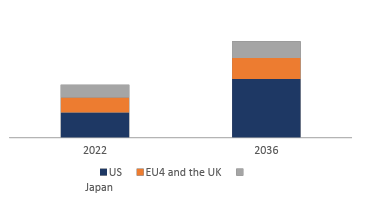
The AOP market size is assessed separately for various countries, including the United States, EU4 (Germany, France, Italy, and Spain), the UK, and Japan. In 2025, the United States held a significant share of the overall 7MM (Seven Major Markets) AOP market, primarily attributed to the country's higher diagnosed Incidence of the condition and the elevated cost of the available treatments. This dominance is projected to persist, especially with the potential early introduction of new products.
|
Country-wise Market Size Distribution of Acute Ocular Pain |
 |
Acute Ocular Pain Market Size by Therapies
AOP Market Size by Therapies is categorized into current and emerging markets for the study period 2022–2036.
|
Market Share Distribution of Acute Ocular Pain (AOP) by Therapies in 2036 |
 |
Note: Detailed market segment assessment will be provided in the final report.
Acute Ocular Pain Drugs Uptake
This section focuses on the sales uptake of potential of AOP drugs that have recently been launched or are anticipated to be launched in the AOP market between 2022 and 2036. It estimates the market penetration of AOP drugs for a given country, examining their impact within and across classes and segments. It also touches upon the financial and regulatory decisions contributing to the probability of success (PoS) of the drugs in the AOP market.
The emerging AOP therapies are analyzed based on various attributes such as safety and efficacy in randomized clinical trials, order of entry and other market dynamics, and the unmet need they fulfill in the AOP market.
Note: Detailed assessment of drug uptake and attribute analysis will be provided in the full report on Acute Ocular Pain (AOP).
Acute Ocular Pain Market Access and Reimbursement
DelveInsight’s ‘Acute Ocular Pain – Market Insights, Epidemiology, and Market Forecast – 2036’ report provides a descriptive overview of the market access and reimbursement scenario of AOP.
This section includes a detailed analysis of the country-wise healthcare system for each therapy, enlightening the market access, reimbursement policies, and health technology assessments.
KOL Views
To keep up with current AOP market trends and fill gaps in secondary findings, we interview KOLs and SMEs’ working in AOP domain. Their opinion helps understand and validate current and emerging therapies and treatment patterns or AOP market trends. This will support the clients in potential upcoming novel treatments by identifying the overall scenario of the market and the AOP unmet needs.
Acute Ocular Pain: KOL Insights
DelveInsight's analysts connected with 50+ KOLs to gather insights; however, interviews were conducted with 15+ KOLs in the 7MM. These KOLs were from organizations, institutes, and hospitals, such as National Jewish Health, Charité – Universitätsmedizin Berlin, Hospital Clínic de Barcelona, Humanitas Research Hospital, Hôpital Européen Georges-Pompidou, Royal Brompton Hospital, and Jikei University Hospital among others.
|
Region |
Key Opinion Leaders (KOLs) and Subject Matter Experts (SMEs) |
|
United States |
“AOP remains a significant clinical challenge because symptom severity often correlates poorly with objective ocular findings, leading to delayed diagnosis and suboptimal management, particularly in patients with neuropathic pain components.” |
|
Germany |
“While current therapies effectively address inflammation and postoperative pain, there remains a substantial unmet need for treatments capable of delivering durable relief by targeting the underlying neuroinflammatory and corneal nerve dysfunction pathways driving chronic ocular pain.” |
Note: Detailed assessment of KOL Views will be provided in the full report on Acute Ocular Pain (AOP).
Competitive Intelligence Analysis
We conduct a Competitive and Market Intelligence analysis of the AOP market, utilizing various Competitive Intelligence tools such as SWOT analysis and Market entry strategies. The inclusion of these analyses is contingent upon data availability, ensuring a comprehensive and well-informed assessment of the market landscape and competitive dynamics.
Acute Ocular Pain Pipeline Development Activities
The report offers an analysis of therapeutic candidates in Phase I/II and III stages and examines companies involved in developing targeted therapeutics for AOP. It provides valuable insights into the advancements and progress of potential treatments in clinical development for this condition.
Pipeline Development Activities
The report covers information on collaborations, acquisition and merger, licensing, patent details, and other information for emerging AOP therapies.
Acute Ocular Pain Report Insights
- Acute Ocular Pain Patient Population
- Therapeutic Approaches
- Acute Ocular Pain Pipeline Analysis
- Acute Ocular Pain Market Size and Trends
- Acute Ocular Pain Market Opportunities
- Impact of Upcoming Therapies
Acute Ocular Pain Report Key Strengths
- 11 Years Forecast
- The 7MM Coverage
- Acute Ocular Pain Epidemiology Segmentation
- Competitive Landscape
- Highly Analyzed Acute Ocular Pain Market
- Acute Ocular Pain Drugs Uptake
Acute Ocular Pain Report Assessment
- Acute Ocular Pain Current Treatment Practices
- Unmet Needs
- Acute Ocular Pain Pipeline Product Profiles
- Acute Ocular Pain Market Attractiveness
Key Questions
- How common is AOP?
- What are the key findings of AOP epidemiology across the 7MM, and which country will have the highest number of patients during the study period (2022–2036)?
- What are the currently available treatments for AOP?
- What are the disease risk, burden, and unmet needs of AOP?
- At what CAGR is the AOP market and its epidemiology is expected to grow in the 7MM during the forecast period (2026–2036)?
- How would the unmet needs impact the AOP market dynamics and subsequently influence the analysis of the related trends?
- What would be the forecasted patient pool of AOP in the 7MM covering the United States, EU4 (Germany, France, Italy, and Spain), the UK, and Japan?
- Among EU4 and the UK, which country will have the highest number of patients during the forecast period (2026–2036)?
- How many companies are currently developing therapies for the treatment of AOP?
Reasons to buy
- The report will help in developing business strategies by understanding the latest trends and changing treatment dynamics driving the AOP market.
- Insights on patient burden/disease Incidence, evolution in diagnosis, and factors contributing to the change in the epidemiology of the disease during the forecast years.
- To understand the existing market opportunity in varying geographies and the growth potential over the coming years.
- Distribution of historical and current patient share based on real-world prescription data along with reported sales of current treatment in the US, EU4 (Germany, France, Italy, and Spain), the United Kingdom, and Japan.
- Identification of strong upcoming players in the market will help in devising strategies that will help in getting ahead of competitors.
- Detailed analysis and ranking of class-wise potential current and emerging therapies under the attribute analysis section to provide visibility around leading classes.
- Highlights of access and reimbursement policies of approved therapies, barriers to accessibility of off-label expensive therapies, and patient assistance programs.
- To understand the perspective of Key Opinion Leaders around the accessibility, acceptability, and compliance-related challenges of existing treatment to overcome barriers in the future.
- Detailed insights on the unmet needs of the existing market so that the upcoming players can strengthen their development and launch strategy.