

Benign Breast Disease and Early Breast Cancer Market
- The Benign Breast Disease and Early Breast Cancer Market Size in the 7MM is aniticipated to grow with a significant CAGR during the study period (2020-2034)
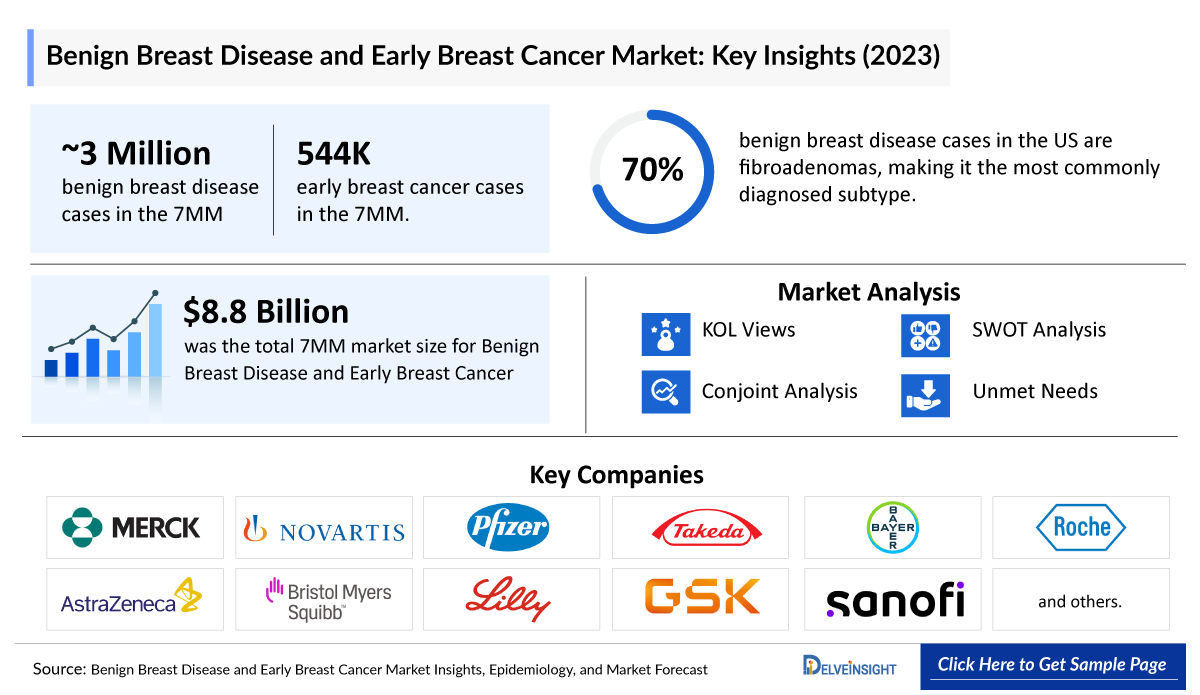
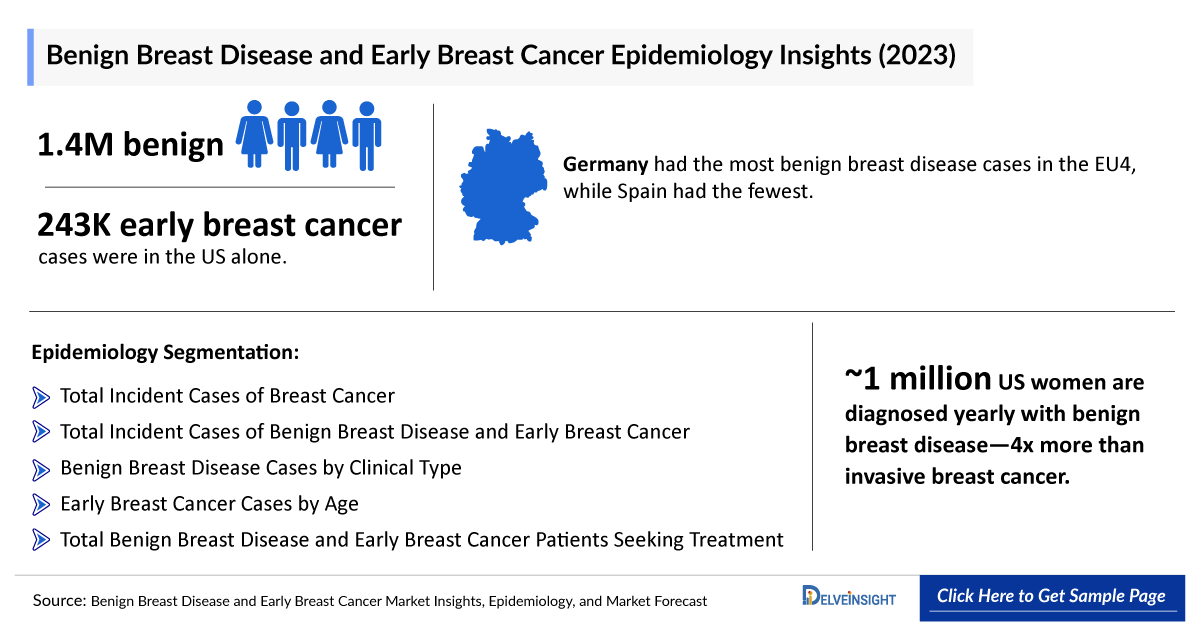
- In the United States, Biopsy-confirmed benign breast disease diagnoses are four times more common than invasive Breast Cancers, affecting ~1 million women annually. There is lucrative potential to seize the marketplace of early-stage cancerous and benign breast disease because it is a broader indication and represents a greater population than an advanced disease.
- In 2023, the market size of benign breast disease and early breast cancer was highest in the US among the 7MM. Amongst EU4 and the UK, Germany accounted for the highest market share in 2023, and Spain captured the least market share.
- The COVID-19 pandemic has dramatically impacted breast cancer screening, early diagnosis, and all cancer treatments: for example, screening programs were halted, some systemic therapies were withheld, and reconstructive and risk-reducing surgeries were not performed.
- Unlike breast cancer, data and guidelines for investigating and managing benign breast disease are limited. To date, there are no guidelines available for imaging surveillance after mastectomy.
- Among all the benign breast disease subtypes, fibroadenoma is the most common clinically diagnosed subtype accounting for approximately 70% of all subtypes in the US.
- Even with trends toward increasing mastectomy rates, the current rates of lumpectomy (breast-conserving surgery (~60% nationwide) remain above 50% at American Cancer Society and American College of Surgeons Commission on Cancer (ACS/CoC) centers in the United States. Data also suggests that the European centers have established higher benchmarks for breast-conserving surgeries, expecting that at least 70% of women with early breast cancer undergo breast-conserving surgery. The National Accreditation Center for Breast Cancer Standards in the US concurs with the European Society of Breast Cancer Specialists (EUSOMA-multi-institutional European database) recommendations, as it establishes that breast-conserving surgery should be offered or performed in early-stage breast cancer (stages 0, I, II) to at least 50% of cases.
- Novel technologies, patients’ awareness of breast cancer early detection methods as a standard of healthcare, and compliance to screening help detect breast cancer at very early stages.
- Minimally invasive techniques like cryoablation and laser ablation have gained attention in the past few years as an alternative to surgical excision, potentially reducing complications, improving tencosmesis, and reducing hospital stays.
Key Factors Driving Benign Breast Disease and Early Breast Cancer Market
Benign Breast Disease and Early Breast Cancer Patient Pool and Rising Prevalence
Benign breast disease (BBD) and early breast cancer affect a substantial population worldwide, with biopsy-confirmed BBD diagnoses in the US occurring four times more frequently than invasive breast cancers, impacting approximately 1 million women annually. This broader patient population creates significant market potential for therapies targeting both benign and early-stage malignant conditions.
Benign Breast Disease and Early Breast Cancer Market Growth and Treatment Landscape
The 7MM market for benign breast disease and early breast cancer is projected to grow at a significant CAGR from 2020 to 2034. Current treatment strategies include breast-conserving surgery (lumpectomy), mastectomy, and minimally invasive procedures. Despite rising mastectomy trends, breast-conserving surgery rates remain above 50% in US centers, with European centers targeting at least 70% for early-stage breast cancer (stages 0–II). The COVID-19 pandemic temporarily disrupted screening, diagnosis, and treatment programs, highlighting the importance of early detection and standardized care. Novel technologies and increased patient awareness are further driving early diagnosis and improving treatment outcomes.
Benign Breast Disease and Early Breast Cancer Emerging Therapies and Innovations
Minimally invasive techniques such as cryoablation and laser ablation are gaining attention as alternatives to surgical excision. These approaches aim to reduce complications, enhance cosmetic outcomes, and shorten hospital stays, offering promising adjuncts or alternatives to conventional surgery.
Benign Breast Disease and Early Breast Cancer Clinical Trials and Competitive Landscape
Several clinical trials are ongoing to evaluate novel therapies, devices, and minimally invasive interventions for benign breast disease and early breast cancer. Key companies actively involved in developing these therapies include Abbott Laboratories Inc., AbbVie Inc., Amgen Inc., Astellas Pharma Inc., AstraZeneca Plc, Biocon Ltd., Bristol Myers Squibb Company, Eisai Inc., and others. The competitive landscape reflects robust efforts to improve early detection, treatment efficacy, and patient quality of life in this high-prevalence market.
DelveInsight’s “Benign Breast Disease and Early Breast Cancer Market Insights, Epidemiology and Market Forecast – 2034” report delivers an in-depth understanding of the Benign Breast Disease and Early Breast Cancer, historical and forecasted epidemiology as well as the Benign Breast Disease and Early Breast Cancer therapeutics market trends in the United States, EU4 (Germany, Spain, Italy, and France) and the United Kingdom, and Japan.
The benign breast disease and early breast cancer market report provides current treatment practices, market share of individual interventions, and current and forecasted 7MM benign breast disease and early breast cancer market size from 2020 to 2034. The report also covers current benign breast disease and early breast cancer treatment practices and unmet medical needs to curate the best opportunities and assess the market’s underlying potential.
|
Study Period |
2020 to 2034 |
|
Forecast Period |
2024-2034 |
|
Geographies Covered |
|
|
Benign Breast Disease and Early Breast Cancer Market |
|
|
Benign Breast Disease and Early Breast Cancer Market Size | |
|
Benign Breast Disease and Early Breast Cancer Companies |
Merck & Co., Inc, Novartis AG, Pfizer Inc, Takeda Pharmaceutical Company, Bayer AG, F. Hoffmann-La Roche Ltd., AstraZeneca, Bristol-Myers Squibb Company, Eli Lilly and Company, GlaxoSmithKline plc, Sanofi, and others. |
|
Benign Breast Disease and Early Breast Cancer Epidemiology Segmentation |
|
Benign Breast Disease and Early Breast Cancer Treatment Market
Benign Breast Disease and Early Breast Cancer Overview
Benign breast disease is a spectrum of lesions that are frequently discovered on clinical examination, routine imaging, by the patient on self-examination, or due to mastalgia, and after appropriate imaging and indicated sampling confirm a benign diagnosis, treatment is directed to symptomatic relief and the patient education without additional surgical management. Benign lesions are more common at younger ages, with benign breast disease beginning to rise in the second decade and peaking between the ages of 40 and 50.
Early breast cancer means cancer has not spread beyond the breast or the lymph nodes in the armpit on the same side of the body. So, cancer has not spread to any other part of the body. The number staging system divides breast cancers into different stages. Early breast cancer includes Stage 0, Stage I, and Stage II.
Benign Breast Disease and Early Breast Cancer Diagnosis
The tests and procedures used to diagnose a benign breast condition are often the same as those used to diagnose early breast cancer. The goals of diagnosis are to ensure that the growth or other change detected is benign and determine whether the condition is associated with any increase in cancer risk. Clinical breast examination, and diagnostic imaging, including X-ray, ultrasound, MRI, and mammography, are some diagnostic tests used for diagnosis. Furthermore, a biopsy is also considered to diagnose benign breast disease and early breast cancer.
Benign Breast Disease and Early Breast Cancer Treatment
Most types of benign breast disease do not require treatment. The healthcare provider may recommend treatment if one has atypical hyperplasia or a different kind of benign breast disease that increases the future risk of breast cancer. Similarly, treating early breast cancer aims to eliminate cancer and keep it from returning, for which a treatment plan is made based on medical and personal choices. Treatment includes surgery, radiation therapy, chemotherapy, hormone therapy, immunotherapy, and targeted therapy.
Benign Breast Disease and Early Breast Cancer Epidemiology
As the market is derived using a patient-based model, the Benign Breast Disease and Early Breast Cancer epidemiology chapter in the report provides historical as well as forecasted epidemiology segmented by total incident cases of breast cancer, total incident cases of benign breast disease and early breast cancer, benign breast disease cases by clinical type, early breast cancer cases by age, and total benign breast disease and early breast cancer patients seeking treatment in the 7MM covering the United States, EU4 countries (Germany, France, Italy, and Spain), the United Kingdom, and Japan from 2020 to 2034.
- The total Benign Breast Disease and Early Breast Cancer Incidence Cases in the 7MM comprised approximately 2.9 million and 544,200 cases respectively, in 2023 and are projected to increase during the forecasted period.
- The United States contributed to the largest incident population of benign breast disease and early breast cancer, acquiring ~49% of the 7MM, followed by EU4 and the UK, and Japan in 2023.
- The total number of incident cases of benign breast disease and early breast cancer in the United States was around 1.4 million and 243,500 cases, respectively, in 2023.
- Among the EU4 countries, Germany accounted for the largest number of benign breast disease cases, followed by France, whereas Spain accounted for the lowest number of cases in 2023.
- Most benign tumors of the breast do not require treatment, because such tumors or lesions are not life threatening and it takes years to progress into cancer. After diagnosing a benign breast lump, a physician may simply suggest a "wait-and-watch" approach to monitor the mass for changes. Surgical removal may be recommended if a noncancerous mass grows large enough to cause discomfort or press on a vital structure, such as a nerve or blood vessel. Data in the secondary domain suggests that nearly 30%-50% of BBD cases receive any kind of treatment at some time in their life.
Benign Breast Disease and Early Breast Cancer Interventions
Benign Breast Disease and Early Breast Cancer Marketed Drugs
ECHOPULSE: Theraclion
ECHOPULSE, developed by Theraclion, is the first robotic and non-invasive solution for echotherapy treatment (High-Intensity Focused Ultrasound HIFU) of breast fibroadenoma. The therapeutic ultrasound is combined with a standard ultrasound beam to control the accuracy of the treatment. It can be operated by a single person in a nonsurgical environment and leaves no scars, and maintains the thyroid function and the integrity of the breast tissue.
ProSense: IceCure Medical
ProSense by IceCure Medical is a liquid-nitrogen-based cryoablation system that allows for minimally invasive breast cancer treatment for the treatment of T1 invasive breast cancer and/or patients unsuitable for a surgical alternative for breast cancer. IceCure’s unique ultra-slim probe freezes targeted tissue using advanced cryotherapy technology within minutes.
Guided by CT or ultrasound, the probe is inserted into the tumor, and liquid nitrogen generates sub-zero temperatures to turn the tumor into an ice ball. A freeze-thaw-freeze cycle destroys the targeted tissue immediately, leaving adjacent healthy tissue undamaged. The necrotic debris is eventually absorbed by the body.
Note: Detailed therapies assessment will be provided in the final report.
Benign Breast Disease and Early Breast Cancer Market Outlook
The current market has been segmented into different commonly used therapeutic interventions based on the prevailing treatment pattern across the 7MM, which presents minor variations in the overall intervention patterns. Surgery including lumpectomy, mastectomy, minimally invasive procedures, and surgical excision in benign breast disease, are the major interventions covered in the forecast model.
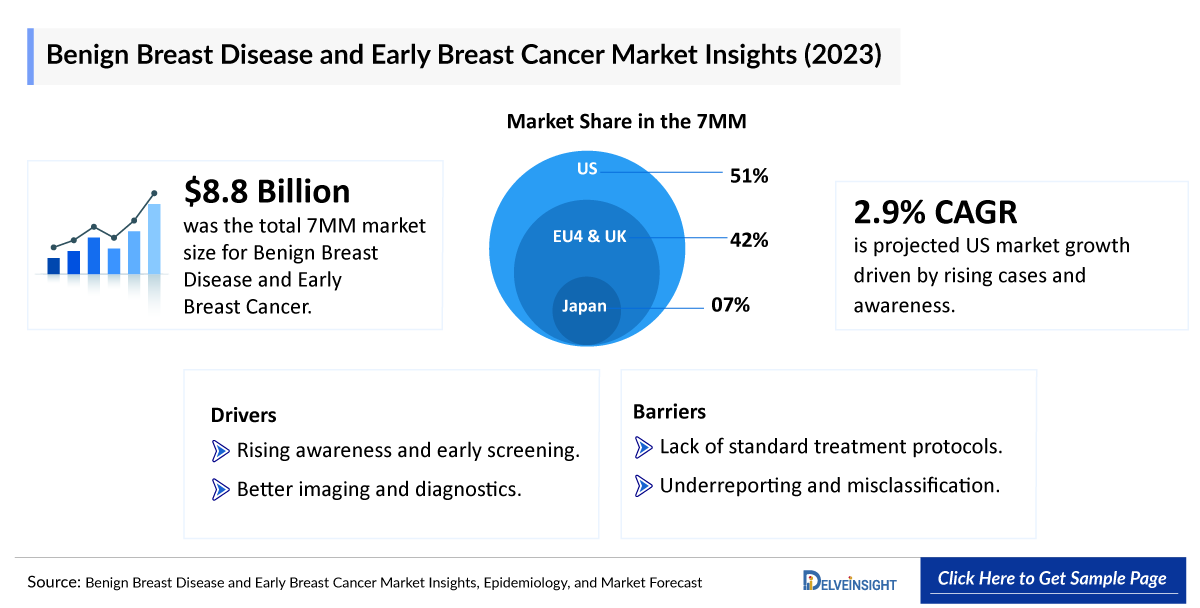
- The total market size of Benign Breast Disease and Early Breast Cancer in the 7MM is approximately USD 8,800 million in 2023 and is projected to increase during the forecast period (2024–2034).
- The US accounted for the maximum share of the total market size in the 7MM, i.e., ~51%, followed by EU4 and the UK, capturing around 42% market share.
- The market size in the United States will increase at a CAGR of 2.9% due to an increase in the patient pool and awareness of the disease.
- Among EU4 countries, Germany accounts for the maximum market size in 2023, while Spain occupies the bottom of the ladder.
Market Size of Benign Breast Disease and Early Breast Cancer by Surgery Options in the US in 2023
KOL Views
To keep up with current market trends, we take KOL’s, and SME’s opinions working in the domain through primary research to fill the data gaps and validate our secondary research. Industry Experts were contacted for insights on benign breast disease and early breast cancer evolving treatment landscape, patient reliance on conventional surgical options, patient acceptability of other surgical alternatives, and uptake of newer devices along with challenges related to accessibility, including Medical/scientific writers, Medical Oncologists, and Professors, MD from Department of Oncoplastic Breast Surgery Croydon University Hospital, London, UK, MD from Department of General Surgery Pullman Regional Hospital and Clinic Network, MD from Duke University, Durham, and Others.
DelveInsight’s analysts connected with 50+ KOLs to gather insights; however, interviews were conducted with 15+ KOLs in the 7MM. Centers such as MD Anderson Cancer Center, University of Edinburg, Cancer Research UK Barts Centre in London, New York Presbyterian Hospital/Weill Cornell Medical College, etc., were contacted. Their opinion helps understand and validate current treatment patterns, benign breast disease, and early breast cancer market trends. This will support the clients in potential upcoming novel treatments by identifying the overall scenario of the market and the unmet needs.
Benign Breast Disease and Early Breast Cancer Qualitative Analysis
We perform Qualitative and market Intelligence analysis using various approaches, such as SWOT analysis. In the SWOT analysis, strengths, weaknesses, opportunities, and threats in terms of disease diagnosis, patient awareness, patient burden, competitive landscape, cost-effectiveness, and geographical accessibility of therapies are provided. These pointers are based on the Analyst’s discretion and assessment of the patient burden, cost analysis, and existing and evolving treatment landscape.
Benign Breast Disease and Early Breast Cancer Market Access and Reimbursement
Breast cancer has the highest treatment cost of any cancer, accounting for 14% of all cancer treatment costs. Medicare pays for certain preventive healthcare services and screening tests to help find cancer. Part B also covers diagnostic mammograms more frequently than once a year when medically necessary. Patients pay 20% of the Medicare-approved amount for diagnostic mammograms; the Part B deductible applies. However, in Europe, inappropriate reimbursement and funding rules and regulations act as disincentives to best breast cancer care or, at worst, hinder best care. Reimbursement policies have rarely evolved with advances in breast cancer care such as outpatient (ambulatory) care rather than inpatient admission, use of oral or SC anticancer drugs rather than day-hospital IV administration, oncoplastic surgery techniques to minimize mastectomy rates, breast reconstructive surgery, and risk-reducing surgery for BRCA mutation carriers, or use of hypofractionated breast radiation therapy. Although each European country, region, and center must understand how their reimbursement policies may hinder best care and find solutions, the problems are similar throughout Europe, and some solutions can be broadly applied.
The report further provides detailed insights on the country-wise accessibility and reimbursement scenarios, cost-effectiveness scenario of approved therapies, programs making accessibility easier and out-of-pocket costs more affordable, insights on patients insured under federal or state government prescription drug programs, etc.
Scope of the Benign Breast Disease and Early Breast Cancer Market Report
- The report covers a segment of key events, an executive summary, descriptive overview of benign breast disease and early breast cancer, explaining its causes, signs and symptoms, classification, and currently available interventions.
- Comprehensive insight has been provided into the epidemiology segments and forecasts, the future growth potential of diagnosis rate, disease progression with treatment guidelines.
- Additionally, an all-inclusive account of both the current interventions, along with the elaborative profiles of newer surgical options will have an impact on the current treatment landscape.
- A detailed review of the benign breast disease and early breast cancer market, historical and forecasted market size, market share by surgery options, detailed assumptions, and rationale behind our approach is included in the report, covering the 7MM drug outreach.
- The report provides an edge while developing business strategies, by understanding trends, through SWOT analysis and expert insights/KOL views, patient journey, and surgery preference that help shape and drive the 7MM benign breast disease and early breast cancer market.
Benign Breast Disease and Early Breast Cancer Report Insights
- Benign Breast Disease and Early Breast Cancer Patient Population
- Benign Breast Disease and Early Breast Cancer Therapeutic Approaches
- Benign Breast Disease and Early Breast Cancer Market Size and Trends
- Existing and future Market Opportunity
Benign Breast Disease and Early Breast Cancer Report Key Strengths
- 11 years Forecast
- 7MM Coverage
- Benign Breast Disease and Early Breast Cancer Epidemiology Segmentation
- Key Cross Competition
Benign Breast Disease and Early Breast Cancer Report Assessment
- Current Benign Breast Disease and Early Breast Cancer Treatment Practices
- Benign Breast Disease and Early Breast Cancer Unmet Needs
- Benign Breast Disease and Early Breast Cancer Market Attractiveness
- Qualitative Analysis (SWOT)
- Benign Breast Disease and Early Breast Cancer Market Drivers
- Benign Breast Disease and Early Breast Cancer Marke Barriers
Key Questions Answered In The Benign Breast Disease and Early Breast Cancer Market Report
Benign Breast Disease and Early Breast Cancer Market Insights
- What were the total market size of benign breast disease and early breast cancer, the market size by surgery options, market share (%) distribution in 2020, and what would it look like in 2034? What are the contributing factors for this growth?
- What are the pricing variations among different geographies for different types of surgeries?
- How would the market drivers, barriers, and future opportunities affect the market dynamics and subsequent analysis of the associated trends?
- What will be the market share of different surgery options among lumpectomy, mastectomy, minimally invasive surgery, and others?
- Why the patient share of mastectomy is increasing in the US?
- Will minimally invasive surgical procedures be the preferred choice for benign breast disease?
Benign Breast Disease and Early Breast Cancer Epidemiology Insights
- What are the disease risk, burdens, and unmet needs of benign breast disease and early breast cancer? What will be the growth opportunities across the 7MM with respect to the patient population pertaining to benign breast disease and early breast cancer?
- What is the historical and forecasted benign breast disease and early breast cancer patient pool in the United States, EU4 (Germany, France, Italy, and Spain), the United Kingdom, and Japan?
- What factors affect the increase in the diagnosis of benign breast disease and early breast cancer cases?
- What percentage of people with early breast cancer and benign breast disease seek treatment?
Benign Breast Disease and Early Breast Cancer Current Treatment Scenario
- What are the current options for the treatment of benign breast disease and early breast cancer? What are the current guidelines for treating benign breast disease and early breast cancer in the US and Europe?
- What are the recent novel devices, procedures, and technologies developed to overcome the limitation of existing therapies?
- What is the cost burden of approved interventions on the patient?
- Patient acceptability in terms of preferred surgical options as per real-world scenarios?
- What are the country-specific accessibility issues of diagnostic and surgical procedures?
- What are the 7MM historical and forecasted benign breast disease and early breast cancer market?
Reasons to Buy Benign Breast Disease and Early Breast Cancer Forecast Report
- The report will help develop business strategies by understanding the latest trends and changing treatment dynamics driving the benign breast disease and early breast cancer market.
- Insights on patient burden/disease prevalence, evolution in diagnosis, and factors contributing to the change in the epidemiology of the disease during the forecast years
- Understand the existing market opportunity in varying geographies and the growth potential over the coming years.
- Distribution of historical and current patient share based on real-world prescription data along with reported sales of approved products in the US, EU4 (Germany, France, Italy, and Spain) the United Kingdom, and Japan.
- Highlights of Access and Reimbursement policies of approved interventions, barriers to accessibility of expensive off-label therapies, and patient assistance programs.
- To understand Key Opinion Leaders’ perspectives around the accessibility, acceptability, and compliance-related challenges of existing treatment to overcome barriers in the future.
- Detailed insights on the unmet need of the existing market so that the upcoming players can strengthen their development and launch strategy.
Stay Updated with us for Recent Articles:-
- Metastatic HER2-Positive Breast Cancer
- Estrogen Receptor Positive Breast Cancer: Market Outlook
- Global HR+/ HER2- Breast Cancer Market Scenario
- How HR+/ HER2- Breast Cancer Emerging Drugs Will Transform the Market?
- HR-positive/ HER2-negative Breast Cancer Market Insights: Upcoming Therapies and Market Analysis
- Breast Cancer: Understand Your Breasts, Recognize the Symptoms
- Key Facts To Know About Triple-Negative Breast Cancer In The Breast Cancer Awareness Month
- 7 Most Common Myths About Breast Cancer Demystified
- Roche’s HER2-Positive Breast Cancer Treatment Franchise
- Latest DelveInsight Blogs