Cardiac Monitoring Devices Market Summary
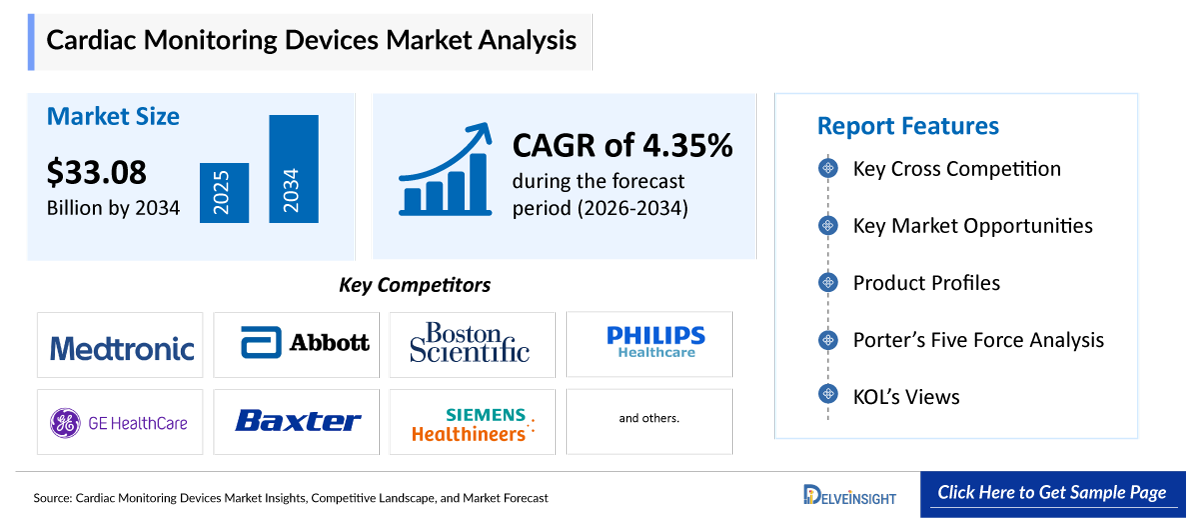
- The cardiac monitoring devices market size is estimated at USD 22.54 billion in 2025 and is projected to reach USD 33.08 billion by 2034. Growth is anchored in the rising global burden of cardiovascular disease, rapid expansion of remote and ambulatory patient monitoring, and growing adoption of AI-enabled and wireless cardiac monitoring technologies.
- The global cardiac monitoring devices market is growing at a CAGR of 4.35% during the forecast period from 2026 to 2034.
- By product type, the Electrocardiogram (ECG) Devices segment dominated the cardiac monitoring devices market with a 35% share in 2025.
- By monitoring type, the continuous cardiac monitoring segment dominated the cardiac monitoring devices market with a 46% share in 2025.
- By technology, the Wireless Monitoring Systems segment dominated the cardiac monitoring devices market with a 58% share in 2025.
- By end-user, the hospitals segment dominated the cardiac monitoring devices market with a 46% share in 2025.
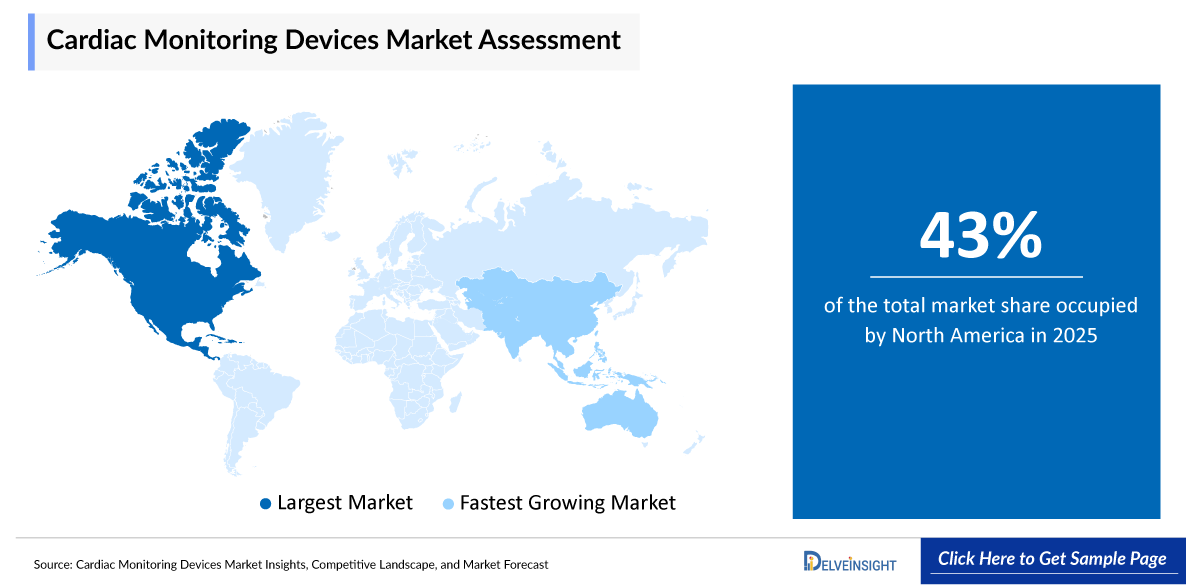
- North America dominated the global Cardiac Monitoring Devices market revenue with a 43% share in 2025, representing the highest regional market share globally.
A cardiac monitoring device is a diagnostic or surveillance technology that continuously or intermittently records the heart's electrical and physiological activity to detect, track, and manage cardiovascular abnormalities such as arrhythmias, ischemia, and heart failure. Because cardiovascular disease remains the leading cause of death worldwide, hospitals, cardiac specialty centers, ambulatory surgical centers, and increasingly patients' homes rely on a broad spectrum of devices spanning electrocardiogram (ECG) systems, implantable cardiac monitors, cardiac output monitoring devices, cardiac rhythm management (CRM) monitoring devices, wearable cardiac monitoring devices, telemetry monitoring systems, and other specialized tools.
The market is organized by product type across these device categories; by monitoring type, spanning continuous, intermittent, real-time remote, and ambulatory cardiac monitoring; by technology, including wired, wireless, and AI-enabled monitoring systems; and by end-user, led by hospitals. Driven by the rising prevalence of arrhythmias and heart failure, the shift from episodic to continuous and remote monitoring, and rapid advances in AI-enabled diagnostics and miniaturized wearable sensors, cardiac monitoring devices have become essential infrastructure underpinning early cardiovascular diagnosis, chronic disease management, and value-based cardiac care.
Cardiac Monitoring Devices Market Key Growth Drivers
- The rising global burden of cardiovascular disease is expanding demand for early and continuous cardiac diagnostics, with the World Health Organization estimating 17.9 million deaths annually from cardiovascular disease, representing approximately 32% of all global deaths.
- Rapid adoption of remote patient monitoring and reimbursement expansion is driving demand for ambulatory and home-based cardiac monitoring.
- Manufacturers are accelerating regulatory approvals and product launches, including Abbott's expanded FDA approval for its CardioMEMS heart-failure monitoring reader and continued competition among Abbott, Boston Scientific, and Medtronic in long-battery-life implantable cardiac monitors.
- Strategic M&A and investment are strengthening AI-enabled and connected monitoring portfolios, including Philips' acquisition of CardioSense AI, GE HealthCare's acquisition of BioSignal Technologies, and AliveCor's acquisition of Wearable Heart Analytics.
- Growing clinical and commercial adoption of implantable loop recorders for long-term arrhythmia surveillance, supported by miniaturization and AI-assisted ECG analysis, is expanding CDMO-adjacent demand for implantable cardiac monitors.
- The convergence of AI-enabled analytics, wireless connectivity, remote monitoring reimbursement, and rising cardiovascular disease prevalence is expected to sustain steady growth in the market through 2034.
Key Companies in Cardiac Monitoring Devices Market
The competitive landscape is led by the following active players:
- Medtronic
- Abbott Laboratories
- Boston Scientific
- Philips Healthcare
- GE HealthCare
- Nihon Kohden
- Siemens Healthineers
- Baxter
- Edwards Lifesciences
- Hillrom (Welch Allyn), and others
For illustrative purposes, only the top 10 companies are listed in the Table of Contents. The report may include analysis and references to additional companies relevant to the market assessment.
Cardiac Monitoring Devices Market Size
The following snapshot summarizes the principal report metrics for the cardiac monitoring devices market.
All market values are expressed in USD and represent DelveInsight estimates synthesized from primary and secondary research.
Factors Contributing to the Growth of the Cardiac Monitoring Devices Market
Cardiac Monitoring Devices Market Drivers
- Rising Global Burden of Cardiovascular Disease: The most fundamental driver of the Cardiac Monitoring Devices market is the persistently high and rising global burden of cardiovascular disease. The World Health Organization estimates that cardiovascular disease causes 17.9 million deaths annually, accounting for approximately 32% of all deaths worldwide, with arrhythmias, ischemic heart disease, and heart failure among the leading contributors. Sedentary lifestyles, obesity, diabetes, and hypertension are expanding the at-risk population, particularly in aging societies across North America, Europe, and parts of Asia-Pacific. This growing disease burden is directly increasing demand for ECG systems, Holter and event monitors, implantable cardiac monitors, and telemetry systems capable of detecting life-threatening arrhythmias and guiding timely intervention. As cardiovascular disease prevalence continues to climb, healthcare systems are prioritizing early diagnosis and continuous surveillance, anchoring sustained demand for cardiac monitoring devices through 2034.
- Expanding Adoption of Remote Patient Monitoring and Home-Based Cardiac Care: A structural shift toward remote and home-based cardiac care is significantly expanding the addressable market. Healthcare systems are formally adopting remote patient monitoring to reduce hospital readmissions, manage chronic cardiovascular conditions, and extend care beyond the hospital walls, supported by expanding reimbursement codes for remote physiologic monitoring. The ambulatory cardiac monitoring devices segment alone is projected to grow from USD 7.91 billion in 2025 to USD 19.53 billion by 2034, reflecting rising use of prescribed event monitors, patch-based recorders, and mobile cardiac telemetry devices that transmit data to clinicians for review. This transition from episodic, in-clinic testing toward continuous, connected, and value-based cardiac care is one of the most powerful structural tailwinds for the market across the forecast period.
- Rapid Growth of Wearable and AI-Enabled Cardiac Monitoring: The convergence of wearable technology and digital cardiology is one of the fastest-growing forces in the market. The global wearable cardiac monitoring devices segment is projected to expand from roughly USD 4.68 billion in 2025 to USD 32.16 billion by 2034, growing at a CAGR approaching 24%, as compact, patient-centric devices integrate continuous ECG sensing with cloud connectivity and AI-based arrhythmia detection. Clinical-grade wearables are increasingly complemented by consumer devices from companies such as Apple, Samsung, and Withings that embed ECG sensors into everyday wearables, expanding population-level screening. AI-driven analytics, including AI-based ECG interpretation algorithms shown to improve the diagnostic accuracy of implantable cardiac monitors, are reducing clinician workload and improving diagnostic yield, reinforcing the shift toward continuous, algorithm-assisted cardiac surveillance.
- Rising Adoption of Implantable Cardiac Monitors for Long-Term Arrhythmia Detection: Implantable cardiac monitors are gaining share as clinicians seek higher diagnostic yield for infrequent or asymptomatic arrhythmias, particularly atrial fibrillation. Competitive intensity among Abbott, Boston Scientific, and Medtronic has intensified around battery life and miniaturization, exemplified by Abbott's FDA-cleared Assert-IQ implantable cardiac monitor offering up to six years of continuous monitoring and Boston Scientific's LUX-Dx platform gaining commercial traction since its 2020 launch. Because implantable monitors can continuously record cardiac rhythm for up to several years with minimal patient burden, they are increasingly favored for post-ablation surveillance, cryptogenic stroke work-up, and syncope evaluation, sustaining durable demand for this high-value product category through the forecast period.
- Accelerating Regulatory Approvals and Product Innovation: A steady cadence of regulatory clearances and new product launches is reinforcing commercial momentum. Abbott secured an expanded FDA approval for its CardioMEMS heart-failure monitoring reader, redesigned for portability and ease of use, while Philips launched a smart telemetry platform delivering continuous, enterprise-wide cardiac monitoring connectivity beyond the bedside. Nihon Kohden's in-hospital remote monitoring solution received EU MDR approval, extending multi-location patient surveillance with streamlined EMR integration. Each approval and platform launch strengthens the commercial pipeline of connected, AI-assisted monitoring systems and reinforces demand for compliant, technologically advanced cardiac monitoring infrastructure across hospitals and ambulatory care settings.
- Growing Investment and M&A Activity Strengthening AI and Connected Monitoring Portfolios: Strategic acquisitions are consolidating AI and connected-monitoring capabilities among leading device makers. Philips acquired CardioSense AI to integrate advanced arrhythmia-detection algorithms into its ECG platforms, GE HealthCare acquired BioSignal Technologies to strengthen ECG signal processing and predictive analytics, and AliveCor acquired Wearable Heart Analytics to expand consumer and clinical continuous monitoring software. Independent cardiology platforms are also consolidating, illustrated by CardioOne's acquisition of CardioDiagnostics to strengthen virtual cardiology and remote cardiac monitoring for physician practices. This wave of consolidation is expanding the technological depth, data analytics capability, and connected-care reach of established cardiac monitoring device manufacturers.
Cardiac Monitoring Devices Market Restraints
Despite strong underlying momentum, the Cardiac Monitoring Devices market faces material constraints. The high cost of advanced implantable, wireless, and AI-enabled monitoring systems limits adoption in price-sensitive and emerging markets, while reimbursement policies for remote and ambulatory monitoring vary widely across geographies, complicating widespread adoption of newer technologies. Complex and lengthy regulatory pathways for novel diagnostic algorithms and implantable devices raise development costs and slow time to market. Continuous and remote monitoring systems generate large volumes of physiological data, and clinicians face growing risk of alarm fatigue and false-positive arrhythmia alerts, which can undermine clinical trust and workflow efficiency. Data privacy, cybersecurity, and interoperability concerns associated with wireless and cloud-connected monitoring platforms add further complexity for healthcare IT integration. A shortage of trained cardiac technicians and sonographers in several regions constrains scale-up of monitoring services, while low-cost consumer wearables from non-medical technology companies exert pricing pressure on clinical-grade device makers. Together, these cost, reimbursement, regulatory, data-management, and workforce barriers temper the pace of growth, even as the underlying drivers of rising cardiovascular disease burden and remote-monitoring adoption remain firmly intact.
Cardiac Monitoring Devices Market Segment Analysis
The Cardiac Monitoring Devices Product Type (Electrocardiogram (ECG) Devices, Implantable Cardiac Monitors, Cardiac Output Monitoring Devices, Cardiac Rhythm Management (CRM) Monitoring Devices, Wearable Cardiac Monitoring Devices, Telemetry Monitoring Systems, and Others), Monitoring Type (Continuous Cardiac Monitoring, Intermittent Cardiac Monitoring, Real-Time Remote Monitoring, and Ambulatory Cardiac Monitoring), Technology (Wired Monitoring Systems, Wireless Monitoring Systems, AI-Enabled Cardiac Monitoring, and Others), End-User (Hospitals, Cardiac Specialty Centers, Ambulatory Surgical Centers (ASCs), and Others), and Geography (North America, Europe, Asia-Pacific, and Rest of the World).
By Product Type
Dominant Subsegment: Electrocardiogram (ECG) Devices. The ECG devices category is expected to dominate the market.
Dominant: Electrocardiogram (ECG) Devices ~ 35%
The Electrocardiogram (ECG) Devices segment accounted for approximately 35% of the Cardiac Monitoring Devices market in 2025. ECG devices lead the product-type segmentation because they remain the most widely used, lowest-cost, and clinically foundational tool for detecting arrhythmias, ischemic changes, and conduction disorders across hospitals, clinics, and ambulatory settings. Resting, stress, and Holter ECG systems generate very high, recurring procedure volumes across cardiology, primary care, and emergency medicine, and manufacturers including GE HealthCare, Philips, and Nihon Kohden continue to enhance connectivity, AI-assisted arrhythmia detection, and cloud integration to support tele-cardiology. Implantable cardiac monitors and wearable cardiac monitoring devices are the fastest-growing categories, propelled by rising demand for long-term, continuous rhythm surveillance, but the sheer breadth, affordability, and clinical entrenchment of ECG devices secure the segment's leadership across the forecast period.
By Monitoring Type
Dominant Subsegment: Continuous Cardiac Monitoring. The continuous cardiac monitoring category is expected to dominate the market.
Dominant: Continuous Cardiac Monitoring ~ 46%
The Continuous Cardiac Monitoring segment accounted for approximately 46% of the Cardiac Monitoring Devices market in 2025. Continuous monitoring leads because clinicians increasingly need to capture intermittent, asymptomatic, and low-frequency arrhythmic events that shorter diagnostic windows miss, driving adoption of Holter monitors, telemetry systems, and implantable loop recorders capable of recording cardiac activity over extended periods. Hospitals rely on continuous bedside and telemetry monitoring for high-acuity patients, while post-discharge and ambulatory pathways increasingly extend continuous surveillance into the home. Real-Time Remote Monitoring is the fastest-growing monitoring type as reimbursement for remote physiologic monitoring expands, but the clinical necessity and broad institutional entrenchment of continuous monitoring protocols secure its leadership across the forecast period.
By Technology
Dominant Subsegment: Wireless Monitoring Systems. The wireless monitoring systems category is expected to dominate the market.
Dominant: Wireless Monitoring Systems ~ 58%
The Wireless Monitoring Systems segment accounted for approximately 58% of the Cardiac Monitoring Devices market in 2025. Wireless technology leads because it enables patients to be monitored continuously outside fixed bedside locations, transmitting ECG and rhythm data wirelessly to clinicians, hospital networks, and cloud-based analytics platforms in real time. Wireless connectivity underpins telemetry-beyond-the-bedside platforms such as Philips' smart telemetry system and remote monitoring solutions such as Nihon Kohden's NetKonnect Surveillance, both of which extend enterprise-wide surveillance across care settings. AI-Enabled Cardiac Monitoring is the fastest-growing technology category, propelled by acquisitions such as Philips' purchase of CardioSense AI and GE HealthCare's purchase of BioSignal Technologies, but the operational flexibility and broad installed base of wireless systems secure their leadership across the forecast period.
By End-User
Dominant Subsegment: Hospitals. The hospitals category is expected to dominate the market.
Dominant: Hospitals ~ 46%
The Hospitals segment accounted for approximately 46% of the Cardiac Monitoring Devices market in 2025. Hospitals remain the leading end-user because they manage the highest-acuity cardiac patients, operate dedicated cardiology and intensive care units, and maintain the capital budgets needed for advanced ECG systems, telemetry networks, implantable device programs, and cardiac output monitoring equipment. Comprehensive post-procedural and post-ablation monitoring, along with in-patient arrhythmia surveillance, sustains large, recurring device and consumable demand within hospital networks. Cardiac Specialty Centers and Ambulatory Surgical Centers are growing quickly as more diagnostic and lower-acuity procedures shift to outpatient settings, but the breadth of services, patient acuity, and capital capacity of hospitals secure their leadership across the forecast period.
Cardiac Monitoring Devices Market Region Analysis
Dominant Region: North America
Dominant: North America ~ 43% (Largest)
North America accounted for approximately 43% of the global Cardiac Monitoring Devices market revenue in 2025, representing the highest regional market share globally. The region's dominance reflects advanced healthcare infrastructure, high cardiovascular disease prevalence, favorable reimbursement for remote and ambulatory monitoring, and the concentrated presence of leading manufacturers including Medtronic, Abbott, Boston Scientific, and GE HealthCare. The United States hosts the largest concentration of implantable cardiac monitor programs, telemetry networks, and remote patient monitoring initiatives, supported by expanding reimbursement codes for remote physiologic monitoring. Strong hospital capital spending, rapid adoption of AI-enabled ECG analytics, and a deep pipeline of wearable and implantable device innovation anchor the region's continued leadership across the forecast period.
Fastest Growing Region: Asia-Pacific
Asia-Pacific is the fastest-growing region in the Cardiac Monitoring Devices market. The region's elevated CAGR is driven by rising cardiovascular disease incidence, rapid expansion of hospital and cardiac-care infrastructure, and growing healthcare investment across China, Japan, India, South Korea, and Australia. China is expanding hospital-based cardiac monitoring capacity, Japan is advancing digital and AI-enabled patient monitoring through domestic manufacturers such as Nihon Kohden, and India is emerging as a hub for cost-effective connected monitoring solutions, exemplified by contactless vital-signs monitoring platforms gaining EU MDR approval. Rising disposable incomes, expanding insurance coverage, and government healthcare digitization programs are accelerating adoption, positioning Asia-Pacific as the principal source of incremental growth over the forecast period.
Cardiac Monitoring Devices Regional Commentary
North America
North America accounted for approximately 43% of the global Cardiac Monitoring Devices market revenue in 2025. The United States dominates on the strength of its advanced hospital infrastructure, high cardiovascular disease burden, favorable remote-monitoring reimbursement, and the concentrated presence of leading manufacturers, while continued innovation in implantable cardiac monitors and AI-enabled ECG platforms reinforces the region's leadership.
Europe
Europe is a large and advanced regional market, supported by established EMA and MDR regulatory frameworks, strong public healthcare systems, and a deep base of manufacturers including Siemens Healthineers, Philips, and Schiller AG. Growing adoption of portable and wearable ECG devices among primary care and emergency responders, alongside expanding remote monitoring approvals, reinforces the region's role in supplying both hospital-based and ambulatory cardiac monitoring across Germany, the United Kingdom, France, Italy, and Spain.
Asia-Pacific
Asia-Pacific is the fastest-growing region, propelled by rising cardiovascular disease incidence, rapid hospital and healthcare infrastructure build-out, and growing government healthcare investment across China, Japan, India, South Korea, and Australia. Domestic manufacturers and regional MDR approvals for remote and contactless monitoring platforms are accelerating adoption and clinical-trial activity across the region.
Rest of World
The Rest of World region, spanning Latin America, the Middle East, and Africa, is an emerging growth frontier. Expanding hospital and cardiac-care infrastructure, rising demand for diagnostic ECG and telemetry systems, and gradual alignment of regulatory frameworks with global standards are broadening access, while international partnerships support the build-out of regional monitoring capacity.
Cardiac Monitoring Devices Market Competitive Landscape
The Cardiac Monitoring Devices market is classified as Moderately Concentrated. A group of large, diversified medical technology players with broad cardiology portfolios and global reach, including Medtronic, Abbott Laboratories, Boston Scientific, and Philips Healthcare, anchors the top tier and collectively holds a substantial share of global revenue, while specialized and fast-scaling providers such as Nihon Kohden, Siemens Healthineers, GE HealthCare, Baxter, Edwards Lifesciences, and Hillrom (Welch Allyn) compete through device innovation, AI-enabled analytics, and regional distribution strength, increasing competition in the fastest-growing wearable and remote-monitoring segments.
The competitive landscape can be evaluated across the following dimensions:
- Market concentration: Moderately concentrated, with large diversified medical device leaders anchoring the top tier and a fast-growing field of specialized connected-monitoring providers.
- Leading players: Medtronic, Abbott Laboratories, Boston Scientific, and Philips Healthcare anchor the top tier through broad cardiology portfolios and global distribution networks.
- Geographic reach: Leaders operate global, regionally distributed sales and service networks essential for hospital, ambulatory, and home-based monitoring deployments.
- Product portfolio strength: Top players offer end-to-end portfolios spanning ECG devices, implantable cardiac monitors, cardiac output monitoring, CRM monitoring devices, wearables, and telemetry systems.
- AI and connectivity: Ownership of AI-enabled arrhythmia-detection algorithms and cloud-connected monitoring platforms, such as Philips' CardioSense AI integration, is a decisive competitive advantage.
- Strategic partnerships: Tie-ups between device makers, software developers, and virtual cardiology platforms, such as CardioOne's acquisition of CardioDiagnostics, extend reach into remote and value-based cardiac care.
- M&A activity: Active consolidation, including Philips' acquisition of CardioSense AI, GE HealthCare's acquisition of BioSignal Technologies, and AliveCor's acquisition of Wearable Heart Analytics.
- Manufacturing and R&D capabilities: Miniaturized implantable device engineering, long-battery-life design, and automated ECG signal-processing platforms are key competitive moats.
- Innovation focus: AI-enabled arrhythmia detection, wireless telemetry beyond the bedside, wearable ECG patches, and contactless vital-signs monitoring.
Cardiac Monitoring Devices Market Recent Developmental Activities
- In January 2026, Philips Healthcare acquired CardioSense AI, an AI-powered ECG analytics and arrhythmia detection software company, to integrate advanced diagnostic algorithms into its ECG platforms and strengthen cloud-based remote monitoring offerings. Strategic significance: Expands AI-enabled diagnostic depth and reinforces Philips' connected cardiac monitoring platform.
- In December 2025, GE HealthCare acquired BioSignal Technologies, a developer of integrated ECG signal processing and predictive analytics tools, to enhance its cardiology and perioperative monitoring portfolio. Strategic significance: Strengthens signal-processing and predictive analytics capability across GE HealthCare's monitoring business.
- In March 2026, Abbott Laboratories won expanded FDA approval for an updated heart failure monitoring device reader designed for its CardioMEMS PA Sensor system, redesigned for portability and daily ease of use. Strategic significance: Improves patient adherence and reinforces Abbott's leadership in implantable heart-failure monitoring.
- In November 2025, AliveCor, Inc. acquired Wearable Heart Analytics, a specialist in wearable ECG interpretation and long-term cardiac monitoring software, to expand its consumer and clinical continuous monitoring capabilities. Strategic significance: Broadens wearable ECG analytics reach across consumer and clinical channels.
- In September 2025, Philips Healthcare launched a smart telemetry platform for cardiac monitoring that provides continuous, enterprise-wide connectivity beyond the bedside. Strategic significance: Extends hospital telemetry monitoring across care settings and strengthens Philips' connected-care portfolio.
- In 2025, Nihon Kohden Corporation received EU MDR approval for its in-hospital remote monitoring solution, known as NetKonnect Surveillance in Europe and RemoteSense in the United States, enabling clinicians to remotely monitor patients across multiple healthcare locations with streamlined EMR integration. Strategic significance: Expands Nihon Kohden's European remote-monitoring footprint and multi-site surveillance capability.
- In April 2025, CardioOne acquired CardioDiagnostics to strengthen its virtual cardiology and remote cardiac monitoring capabilities for physician practices. Strategic significance: Expands remote monitoring services available to independent cardiology practices.
- In April 2025, LifeSignals, Inc. launched the UbiqVue 2AYe Holter System in partnership with UltraLinQ Healthcare Solutions, featuring a single-use chest-worn biosensor that collects two-channel ECG and event data for up to five days and transmits encrypted data to a cloud-based analytics platform. Strategic significance: Speeds cardiac monitoring workflows and improves report turnaround for ambulatory Holter monitoring.
- In December 2025, Siemens Healthineers AG launched Syngo.CT Coronary Cockpit software featuring AI-driven, automated plaque analysis and PCI planning to advance coronary artery disease management. Strategic significance: Strengthens Siemens Healthineers' AI-enabled cardiology diagnostics portfolio.
- In 2025, Abbott Laboratories continued to compete with Boston Scientific and Medtronic in the implantable cardiac monitor category following FDA clearance of its Assert-IQ device, which offers up to six years of continuous monitoring versus three-to-four-and-a-half years for competing implantable monitors. Strategic significance: Reinforces Abbott's position in the high-value implantable cardiac monitor segment.
Cardiac Monitoring Devices Market Segmentation
- Cardiac Monitoring Devices Market by Product Type
- Electrocardiogram (ECG) Devices
- Implantable Cardiac Monitors
- Cardiac Output Monitoring Devices
- Cardiac Rhythm Management (CRM) Monitoring Devices
- Wearable Cardiac Monitoring Devices
- Telemetry Monitoring Systems
- Others
- Cardiac Monitoring Devices Market by Monitoring Type
- Continuous Cardiac Monitoring
- Intermittent Cardiac Monitoring
- Real-Time Remote Monitoring
- Ambulatory Cardiac Monitoring
- Cardiac Monitoring Devices Market by Technology
- Wired Monitoring Systems
- Wireless Monitoring Systems
- AI-Enabled Cardiac Monitoring
- Others
- Cardiac Monitoring Devices Market by End-Users
- Hospitals
- Cardiac Specialty Centers
- Ambulatory Surgical Centers (ASCs)
- Others
Cardiac Monitoring Devices Market by Geography
- North America Cardiac Monitoring Devices Market
- United States Cardiac Monitoring Devices Market Size in USD million (2023-2034)
- Canada Cardiac Monitoring Devices Market Size in USD million (2023-2034)
- Mexico Cardiac Monitoring Devices Market Size in USD million (2023-2034)
- Europe Cardiac Monitoring Devices Market
- Germany Cardiac Monitoring Devices Market Size in USD million (2023-2034)
- United Kingdom Cardiac Monitoring Devices Market Size in USD million (2023-2034)
- France Cardiac Monitoring Devices Market Size in USD million (2023-2034)
- Italy Cardiac Monitoring Devices Market Size in USD million (2023-2034)
- Spain Cardiac Monitoring Devices Market Size in USD million (2023-2034)
- Rest of Europe Cardiac Monitoring Devices Market Size in USD million (2023-2034)
- Asia-Pacific Cardiac Monitoring Devices Market
- China Cardiac Monitoring Devices Market Size in USD million (2023-2034)
- Japan Cardiac Monitoring Devices Market Size in USD million (2023-2034)
- India Cardiac Monitoring Devices Market Size in USD million (2023-2034)
- Australia Cardiac Monitoring Devices Market Size in USD million (2023-2034)
- South Korea Cardiac Monitoring Devices Market Size in USD million (2023-2034)
- Rest of Asia-Pacific Cardiac Monitoring Devices Market Size in USD million (2023-2034)
- Rest of the World (RoW) Cardiac Monitoring Devices Market
- Middle East Cardiac Monitoring Devices Market Size in USD million (2023-2034)
- Africa Cardiac Monitoring Devices Market Size in USD million (2023-2034)
- South America Cardiac Monitoring Devices Market Size in USD million (2023-2034)
Cardiac Monitoring Devices Market Recent Industry Trends and Milestones (2023-2026):
|
Category |
Key Developments |
|
Cardiac Monitoring Devices Market Product Approval |
Regulatory momentum is expanding commercial demand. Abbott secured expanded FDA approval for its CardioMEMS heart-failure monitoring reader, redesigned for portability, while its Assert-IQ insertable cardiac monitor offers up to six years of continuous monitoring. Boston Scientific's LUX-Dx and Medtronic's implantable monitor portfolios continue to compete on battery life and diagnostic yield. Nihon Kohden's NetKonnect Surveillance remote monitoring platform received EU MDR approval. Each approval creates durable demand for compliant, technologically advanced monitoring devices across hospital and ambulatory settings. |
|
Cardiac Monitoring Devices Market Launch |
Manufacturers broadened capacity and capability across the value chain. Philips launched a smart telemetry platform providing continuous, enterprise-wide cardiac monitoring connectivity beyond the bedside. LifeSignals launched the UbiqVue 2AYe Holter System with UltraLinQ Healthcare Solutions, and CardioOne acquired CardioDiagnostics to expand virtual cardiology and remote monitoring services. Decentralized, home-based, and ambulatory monitoring expanded to address rising remote-monitoring reimbursement, while AI-enabled analytics improved throughput and diagnostic consistency. |
|
Cardiac Monitoring Devices Market Investment |
Capital and consolidation accelerated across AI-enabled and connected monitoring. Philips acquired CardioSense AI (January 2026), GE HealthCare acquired BioSignal Technologies (December 2025), and AliveCor acquired Wearable Heart Analytics (November 2025). Siemens Healthineers launched Syngo.CT Coronary Cockpit AI software (December 2025), while Dozee, an India-based contactless vital-signs monitoring vendor, secured additional funding and EU MDR approval, reflecting rising investor confidence in connected cardiac monitoring technologies. |
|
Company Strategy |
Medtronic: Broad cardiac rhythm management and cardiac ablation portfolio with expanding pulsed-field ablation momentum. Abbott Laboratories: Leadership in implantable cardiac monitors and heart-failure monitoring through Assert-IQ and CardioMEMS. Boston Scientific: Competitive implantable monitor and rhythm management portfolio through LUX-Dx. Philips Healthcare: AI-enabled ECG analytics and enterprise telemetry expansion through the CardioSense AI acquisition. GE HealthCare: Predictive analytics and signal-processing expansion through the BioSignal Technologies acquisition. Nihon Kohden, Siemens Healthineers, Baxter, Edwards Lifesciences, and Hillrom (Welch Allyn): Specialized ECG, hemodynamic, and bedside monitoring capacity across hospital and ambulatory settings. |
|
Emerging Technologies |
AI-enabled cardiac monitoring is the leading edge of innovation, with algorithm-assisted ECG interpretation improving diagnostic accuracy for implantable and wearable monitors. Wireless, cloud-connected telemetry beyond the bedside, contactless vital-signs sensing, and miniaturized long-battery-life implants address the shift from episodic to continuous surveillance. Consumer wearable integration, expanding remote-monitoring reimbursement, and collaborations between device makers, software developers, and virtual cardiology platforms are accelerating adoption of next-generation cardiac monitoring solutions. |
Cardiac Monitoring Devices Market Startup Funding and Investment Trends
Investment in the Cardiac Monitoring Devices ecosystem has concentrated on AI-enabled ECG analytics, wearable and contactless monitoring, and remote cardiac care platforms. The following companies illustrate recent funding and investment activity and technology focus.
|
Company |
Total Funding |
Funding Stage |
Main Offering |
Core Technology |
|
Octagos Health |
USD 43 million |
Series B |
Atlas AI |
Provides continuous monitoring and data analysis for patients with various cardiac devices, including pacemakers, defibrillators, and ambulatory monitors. |
|
Dozee |
USD 8 million (March 2026 round) |
Growth venture |
Contactless vital-signs monitoring |
Sensor-based, continuous contactless monitoring |
|
Request for unlocking the report of the @ Cardiac Monitoring Devices Market Insights | ||||
Capital is flowing toward providers that combine AI-enabled analytics with connected, patient-centric monitoring. Philips' acquisition of CardioSense AI and GE HealthCare's acquisition of BioSignal Technologies underscore the strategic value of AI-driven ECG analytics, while AliveCor's acquisition of Wearable Heart Analytics and CardioOne's acquisition of CardioDiagnostics reflect consolidation around wearable and virtual cardiology platforms. Emerging providers such as Dozee are scaling contactless, continuous monitoring technology and gaining regulatory traction in Europe. Collectively, these investments signal conviction that AI-enabled analytics, wireless connectivity, and remote, home-based cardiac surveillance will define the next phase of competitive advantage in the global Cardiac Monitoring Devices market.
Key Takeaways from the Cardiac Monitoring Devices Market Report Study
- Market size analysis for the current cardiac monitoring devices market size (2025), and market forecast for 9 years (2026 to 2034).
- Top key product/technology developments, mergers, acquisitions, partnerships, and joint ventures that happened over the last 3 years.
- Key companies dominating the global cardiac monitoring devices market.
- Various opportunities available for competitors in the cardiac monitoring devices market space.
- What are the top-performing segments in 2025? How will these segments perform in 2034?
- Which are the top-performing regions and countries in the current cardiac monitoring devices market scenario?
- Which are the regions and countries where companies should concentrate their opportunities for cardiac monitoring devices market growth in the future?
Target audience who can benefit from this Cardiac Monitoring Devices market report study
- Cardiac monitoring devices product providers
- Research organizations and consulting companies
- Cardiac Monitoring Devices-related organizations, associations, forums, and other alliances
- Government and corporate offices
- Start-up companies, venture capitalists, and private equity firms
- Distributors and traders dealing in cardiac monitoring devices
- Various end-users who want to know more about the cardiac monitoring devices market and the latest technological developments in the cardiac monitoring devices market.
Frequently Asked Questions
Q1. What is the growth rate of the cardiac monitoring devices market?
The cardiac monitoring devices market is projected to expand at a CAGR of 4.35% during the forecast period from 2026-2034
Q2. What is the market size of the Cardiac Monitoring Devices market?
The Cardiac Monitoring Devices market is estimated at USD 22.54 billion in 2025 and is projected to reach USD 33.08 billion by 2034.
Q3. Which region dominates the Cardiac Monitoring Devices market?
North America dominated the Cardiac Monitoring Devices market with a 43% share of global revenue in 2025, supported by advanced healthcare infrastructure, high cardiovascular disease prevalence, favorable reimbursement for remote and ambulatory monitoring, and the concentrated presence of leading manufacturers. Asia-Pacific is the fastest-growing region over the forecast period.
Q4. What are the key drivers of the Cardiac Monitoring Devices market?
The principal drivers are the rising global burden of cardiovascular disease, with the World Health Organization estimating 17.9 million deaths annually from cardiovascular disease; rapid adoption of remote patient monitoring and expanding reimbursement for ambulatory and home-based cardiac care; rapid growth of wearable and AI-enabled cardiac monitoring; rising adoption of implantable cardiac monitors for long-term arrhythmia detection; and accelerating regulatory approvals and strategic M&A strengthening AI and connected monitoring portfolios.
Q5. Who are the major players in the Cardiac Monitoring Devices market?
The leading Cardiac Monitoring Devices companies in the market include - Medtronic, Abbott Laboratories, Boston Scientific, Philips Healthcare, GE HealthCare, Nihon Kohden, Siemens Healthineers, Baxter, Edwards Lifesciences, and Hillrom (Welch Allyn), among other active providers profiled in the Competitive Landscape section, along with AliveCor, CardioOne, and LifeSignals, Inc. Medtronic, Abbott, Boston Scientific, and Philips lead through broad cardiology portfolios and global reach.