
Transdermal Drug Delivery Devices Market Summary
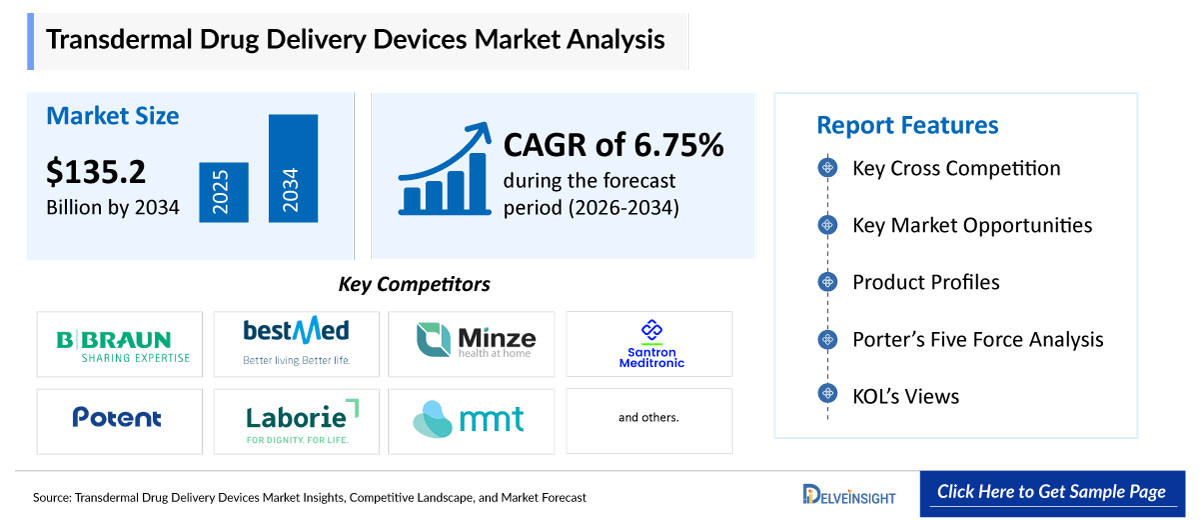
- The Transdermal Drug Delivery Device market is estimated at USD 75,704.90 million in 2025 and is projected to reach USD 135,266.01 million by 2034. Growth is anchored in the rising global prevalence of chronic conditions, the accelerating shift toward third-generation transdermal technologies, and expanding non-invasive treatment adoption across pain management, hormonal, and cardiovascular therapy.
- The global Transdermal Drug Delivery Device market is growing at a CAGR of 6.75% during the forecast period from 2026 to 2034.
- By type, the drug-in-adhesive patches segment dominated the Transdermal Drug Delivery Device market with a 55.44% share in 2025.
- By application, the pain management segment dominated the Transdermal Drug Delivery Device market with an estimated ~38% share in 2025.
- By end-user, the hospitals segment dominated the Transdermal Drug Delivery Device market with an estimated ~52% share in 2025.
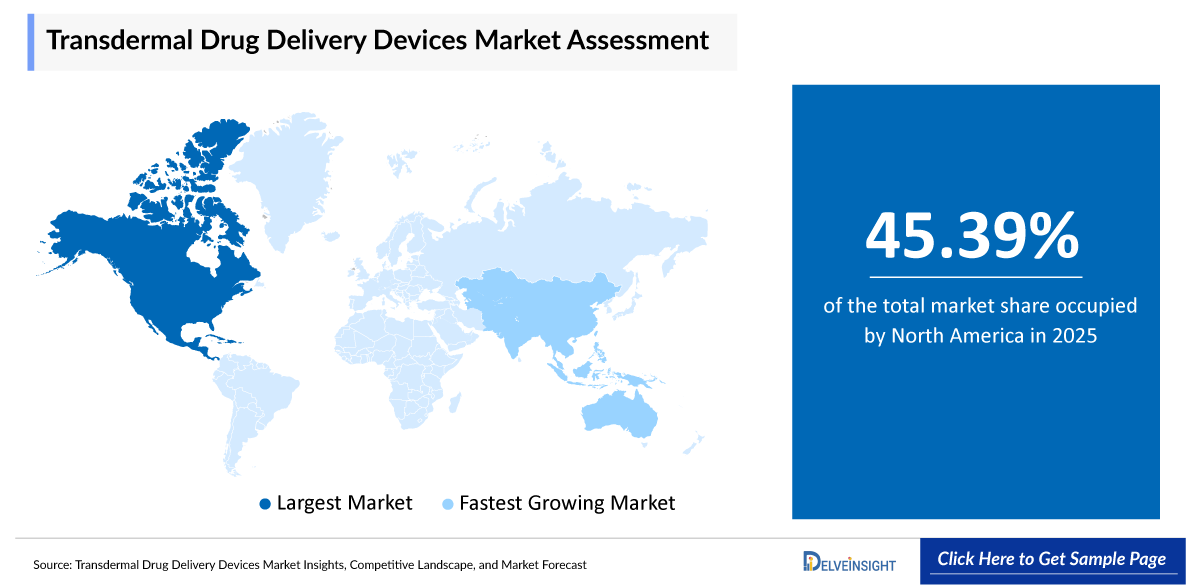
- North America dominated the global Transdermal Drug Delivery Device market revenue with a 45.39% share in 2025, growing at a CAGR of 5.91% during the forecast period, representing the highest regional market share globally.
A transdermal drug delivery device is a non-invasive medical technology, typically a patch, film, or microneedle system, designed to deliver medication through the skin directly into systemic circulation at a controlled and sustained rate. By bypassing gastrointestinal degradation and hepatic first-pass metabolism, these devices provide steady plasma drug concentrations, improved patient compliance, and reduced dosing frequency compared with oral or injectable routes. The market is organized by type across drug-in-adhesive patches, matrix patches, reservoir membrane patches, and microneedle patches; by application across pain management, central nervous system disorders, hormonal applications, cardiovascular disorders, and others; and by end-user across hospitals, ambulatory surgical centers, and others. Driven by the rising burden of chronic disease, an aging population that favors simpler administration routes, and rapid technological progress in microneedle arrays, skin-penetration enhancers, and connected "smart" patches, transdermal drug delivery devices have become an increasingly preferred platform for delivering analgesics, hormones, cardiovascular agents, and central nervous system therapeutics.
Transdermal Drug Delivery Devices Market Key Growth Drivers
- The rapid rise in chronic diseases such as diabetes, cardiovascular disease, and chronic pain is driving demand for convenient, long-term transdermal treatment options.
- Technological advances, including microneedles, nanocarriers, skin-penetration enhancers, and novel adhesives, are expanding the range of drugs deliverable through the skin.
- Growing patient preference for non-invasive, at-home care is increasing adoption of patches and wearables that reduce injections and hospital visits.
- The emergence of "smart"/connected patches integrating sensors and digital monitoring is enabling personalized dosing, adherence tracking, and remote care.
- An aging global population that favors simpler, less invasive administration is supporting sustained market uptake.
- An expanding wave of regulatory approvals and favorable reimbursement pathways is encouraging manufacturer investment and commercialization.
- Expansion of transdermal platforms beyond pain and nicotine into hormones, cardiovascular drugs, vaccines, and biologics, particularly via microneedle systems, is broadening the addressable market.
Key Companies in Transdermal Drug Delivery Devices Market
The competitive landscape is led by the following active device manufacturers:
- B Braun Meslungen AG
- BestMedical
- MINZE HEALTH
- Santron Meditronic.
- Potent Medical
- Laborie
- MEDKONSULT medical technology s.r.o.
- The Prometheus Group®
- HCItalia srl
- DeltaMed
For illustrative purposes, only the top 10 companies are listed in the Table of Contents. The report may include analysis and references to additional companies relevant to the market assessment.
Transdermal Drug Delivery Devices Market Size
The following snapshot summarizes the principal report metrics for the transdermal drug delivery devices market.
|
Report Metrics |
Details |
|
2025 Market Size |
USD 75,704.90 million |
|
2034 Projected Market Size |
USD 135,266.01 million |
|
Growth Rate (2026-2034) |
6.75% CAGR |
|
Largest Market |
North America |
|
Fastest Growing Market |
Asia-Pacific |
|
Market Structure |
Fragmented |
All market values are expressed in USD and represent DelveInsight estimates synthesized from primary and secondary research.
Factors Contributing to the Growth of the Transdermal Drug Delivery Devices Market
Market Drivers
Rapid Rise in Chronic Diseases Requiring Long-Term Medication
The most consistent driver of the Transdermal Drug Delivery Device market is the growing global burden of chronic conditions that require steady, long-term medication, including diabetes, cardiovascular disease, and chronic pain. According to the British Heart Foundation (2024), approximately 620 million people worldwide, or about 1 in 13 individuals, live with heart and circulatory diseases, while coronary heart disease affects an estimated 200 million people globally. The U.S. Centers for Disease Control and Prevention (2024) reported that approximately 4.9% of adults were diagnosed with coronary heart disease in 2022, and an estimated 12.1 million individuals in the United States were projected to have atrial fibrillation by 2023. Transdermal devices deliver antihypertensives, antianginal drugs, anticoagulants, and analgesics at a controlled rate, improving therapeutic outcomes and patient compliance. As the prevalence of chronic disease continues to rise, particularly among aging and increasingly sedentary populations, demand for transdermal delivery platforms expands directly, anchoring market growth through 2034.
Increasing Adoption of Third-Generation Transdermal Technologies
The transition from first-generation passive patches to third-generation transdermal systems, including microneedle arrays, iontophoretic and electroporation-assisted devices, and advanced chemical enhancers, is expanding the range of molecules that can be delivered through the skin, including peptides, biologics, and vaccines. These technologies overcome the natural barrier of the stratum corneum, enabling delivery of larger and more complex therapeutic molecules that were previously limited to injectable routes. As device makers and pharmaceutical sponsors continue to commercialize third-generation platforms, adoption is expected to accelerate across pain management, hormonal, and cardiovascular applications, reinforcing sustained market expansion.
Patient Preference for Non-Invasive, At-Home Care
Patients and caregivers increasingly favor non-invasive, self-administered treatment options that reduce the frequency of injections and hospital visits. Transdermal patches and wearable systems allow patients to manage chronic conditions independently, improving adherence and overall quality of life. This shift toward home-based, patient-friendly care is particularly pronounced among elderly patients and those managing chronic pain, hormonal therapy, or cardiovascular disease, and is prompting healthcare systems to favor transdermal alternatives to reduce clinic burden and lower overall care costs.
Growth of Smart and Connected Patch Technologies
Integration of biosensors and digital monitoring into transdermal patches is enabling a new generation of "smart" devices capable of personalized dosing, real-time adherence tracking, and remote patient monitoring. Smart insulin patches using glucose-responsive microneedle systems and connected pain-management patches are progressing through development and early clinical use. As digital health infrastructure matures and payers increasingly value remote monitoring capability, smart patch technology is expected to become a meaningful growth vector for the market through the forecast period.
Aging Population and Rising Neurological Disease Burden
The global aging population is expanding demand for administration routes that are simpler and less invasive than injections or complex oral regimens. The Alzheimer's Association (2024) estimates that approximately 6.9 million Americans aged 65 and older are living with Alzheimer's disease, while the Parkinson's Foundation (2022) reports that nearly 90,000 people are diagnosed with Parkinson's disease in the United States each year, with total prevalence expected to reach 1.2 million by 2030. The World Health Organization (2024) further estimates that epilepsy affects approximately 50 million people worldwide. Transdermal delivery of central nervous system therapeutics, including donepezil and rivastigmine patches for dementia-related conditions, offers controlled dosing and reduced gastrointestinal side effects, supporting adoption among aging and neurologically vulnerable populations.
Expanding Regulatory Approvals and Favorable Reimbursement Pathways
A growing wave of regulatory approvals is increasing commercial momentum for transdermal drug delivery devices. In February 2024, LTS Lohmann Therapie-Systeme AG launched the UDENYCA on-body injector through its Sorrel platform following FDA approval, while Zydus Lifesciences secured FDA approval for a generic scopolamine patch in 2024 and Sino Biopharmaceutical received the first NMPA approval in China for a domestically produced rivastigmine patch the same year. Each new approval expands the addressable patient population and encourages further manufacturer investment in transdermal platforms, reinforcing market growth across the forecast period.
Strong Industry R&D Investment and Strategic Partnerships
Rising R&D investment and cross-industry collaboration are accelerating product pipelines. Kindeva Drug Delivery expanded its analytical services with a new 32,000-square-foot laboratory in 2024, and its Woodbury, Minnesota facility received FDA inspection and classification the same year to support pharmaceutical, biopharmaceutical, and medical device clients. Nutriband partnered with Kindeva in 2024 to develop an abuse-deterrent fentanyl patch through the FDA's 505(b)(2) pathway, while academic and cross-industry collaborations are increasing in AI-based patch development, biologics, and smart sensor integration. This sustained investment activity is expanding manufacturing capacity and technological depth across the value chain.
Market Restraints
Despite strong momentum, the Transdermal Drug Delivery Device market faces material constraints. Skin irritation, erythema, and edema at the application site remain common limitations that can reduce patient adherence and prompt increased product recalls, tempering adoption of certain formulations. Not all drug molecules are suitable candidates for transdermal delivery, as molecular size, polarity, and skin-permeability characteristics restrict the range of therapeutics that can be effectively administered through this route, even with advanced enhancer and microneedle technologies. In 2025, the FDA issued a warning regarding heat-related overdose risk associated with scopolamine patches, prompting label updates and underscoring the ongoing safety-monitoring burden associated with the category. The imposition of import tariffs on medical devices and components has also increased costs and disrupted supply chains for device manufacturers, prompting strategic shifts in sourcing and manufacturing location. Technical challenges persist across the industry, as many patches continue to struggle with delivering consistent doses or achieving meaningful systemic absorption for more complex molecules. Together, these safety, technical, tariff, and regulatory barriers moderate the pace of growth, even as the underlying drivers of chronic disease burden, technological innovation, and patient preference for non-invasive care remain firmly intact.
Transdermal Drug Delivery Devices Market Segment Analysis
The Transdermal Drug Delivery Devices by Type (Drug-in-adhesive Patches, Matrix Patches, Reservoir Membrane Patches, and Microneedle Patches), Application (Pain Management, Central Nervous System Disorders, Hormonal Applications, Cardiovascular Disorders, and Others), End-User (Hospitals, Ambulatory Surgical Centers, and Others), and Geography (North America, Europe, Asia-Pacific, and Rest of World).
By Type
Dominant Subsegment: Drug-in-adhesive Patches.
Dominant: Drug-in-adhesive Patches ~ 55.44%
The drug-in-adhesive patches segment accounted for 55.44% of the Transdermal Drug Delivery Device market in 2025. Drug-in-adhesive patches are the leading type because the drug is directly incorporated into the adhesive layer, allowing a thin, low-profile design that is easy to apply, comfortable to wear, and does not require needles or invasive procedures. The adhesive layer both secures the patch to the skin and helps regulate the rate of drug release, providing controlled and consistent delivery over a prolonged period while maintaining stable plasma drug levels. The presence of established commercial products, including TRANSDERM-V by Novartis and the Mylan-rivastigmine Patch 10 by Viatris Inc., continues to reinforce category demand and clinical familiarity among prescribers. While microneedle patches are the fastest-growing type on the strength of their ability to deliver larger and more complex molecules, the manufacturing simplicity, cost efficiency, and broad clinical adoption of drug-in-adhesive designs secure the segment's leadership across the forecast period.
By Application
Dominant Subsegment: Pain Management.
Dominant: Pain Management ~ 38%
The pain management segment accounted for an estimated ~38% of the Transdermal Drug Delivery Device market in 2025. Pain management is the leading application because chronic pain affects a very large global patient population and transdermal analgesic patches, including opioid and non-opioid formulations, provide sustained, controlled-release relief while avoiding the peaks and troughs associated with oral dosing. Transdermal delivery also reduces gastrointestinal side effects and supports better adherence among patients requiring long-term pain control following surgery, cancer treatment, or chronic musculoskeletal conditions. Central nervous system disorders and hormonal applications are expanding steadily as patch-based delivery of donepezil, rivastigmine, and hormone-replacement formulations gains adoption, and cardiovascular disorders continue to benefit from nitroglycerin and antihypertensive patches. Nonetheless, the sheer scale of the global chronic pain population and the maturity of transdermal analgesic products secure pain management's leadership across the forecast period.
By End-User
Dominant Subsegment: Hospitals.
Dominant: Hospitals ~ 52%
The hospitals segment accounted for an estimated ~52% of the Transdermal Drug Delivery Device market in 2025. Hospitals lead as the primary end-user because they manage the highest volume of patients requiring continuous pain control, post-operative care, and chronic disease management, and because transdermal devices used in acute and perioperative settings are typically administered and monitored under clinical supervision. Hospitals also serve as the principal point of care for initiating therapy with newer, higher-acuity transdermal products before patients transition to self-administration. Ambulatory surgical centers are expanding steadily as more procedures shift to outpatient settings that rely on transdermal analgesia for post-procedural pain control, while the "others" category, spanning home care and long-term care facilities, is growing quickly as patient preference shifts toward self-administered, at-home therapy. Nonetheless, the scale and clinical intensity of hospital-based care secure its leadership across the forecast period.
Transdermal Drug Delivery Devices Market Region Analysis
Dominant Region: North America
Dominant: North America ~ 45.39% (Largest)
North America accounted for 45.39% of the global Transdermal Drug Delivery Device market revenue in 2025, growing at a CAGR of 5.91% during the forecast period from 2026 to 2034, representing the highest regional market share globally. The region's dominance reflects the growing prevalence of chronic pain, central nervous system disorders, and cardiovascular disease, alongside a steady cadence of new product launches and strong research and development investment. According to the CDC (2024), approximately 4.9% of adults were diagnosed with coronary heart disease in 2022, and by 2023 an estimated 12.1 million individuals in the United States were projected to have atrial fibrillation, while over 795,000 people experience a stroke each year. The Alzheimer's Association (2024) estimates approximately 6.9 million Americans aged 65 and older are living with Alzheimer's disease, and the Parkinson's Foundation (2022) reports nearly 90,000 new Parkinson's diagnoses annually in the United States, with prevalence expected to reach 1.2 million by 2030. This substantial and growing disease burden, combined with demand for patient-friendly solutions that improve adherence and reduce systemic side effects, is accelerating adoption of transdermal technologies. Product development activity continues to reinforce the region's leadership, including the February 2024 launch of the UDENYCA on-body injector by LTS Lohmann Therapie-Systeme AG through its Sorrel platform, which reduces infection risk following chemotherapy.
Fastest Growing Region: Asia-Pacific
Asia-Pacific is the fastest-growing region in the Transdermal Drug Delivery Device market. The region's elevated growth rate is driven by rising chronic disease incidence, rapidly expanding healthcare infrastructure, and growing manufacturing investment across China, Japan, India, South Korea, and Australia. China is scaling domestic transdermal manufacturing and secured its first NMPA-approved domestically produced rivastigmine patch in 2024 through Sino Biopharmaceutical; Japan continues to lead in advanced patch and microneedle innovation, South Korea's Daewoong launched its CLOPAM microneedle platform in 2024, and India offers competitive manufacturing economics that are attracting outsourced production. Rising healthcare expenditure, an expanding base of chronic disease patients, and growing local regulatory capability are accelerating adoption, while regional manufacturers scale quality systems to align with international GMP standards. The combination of high disease burden, manufacturing investment, and improving regulatory pathways positions Asia-Pacific as the principal source of incremental growth over the forecast period.
Regional Commentary
North America
North America accounted for 45.39% of the global Transdermal Drug Delivery Device market revenue in 2025. The United States dominates on the strength of its chronic disease burden, mature clinical infrastructure, FDA regulatory clarity, and steady cadence of product launches, with growing investment in smart-patch and microneedle innovation reinforcing regional leadership.
Europe
Europe is a large and technologically advanced regional market, supported by established EMA regulatory frameworks, a strong base of specialty pharmaceutical and device manufacturers, and rising adoption of hormonal and cardiovascular transdermal therapies across Germany, France, the United Kingdom, Italy, and Spain.
Asia-Pacific
Asia-Pacific is the fastest-growing region, propelled by rising chronic disease incidence, expanding healthcare infrastructure, and growing manufacturing investment across China, Japan, India, South Korea, and Australia, with regional regulatory approvals and microneedle innovation accelerating adoption.
Rest of World
The Rest of World region, spanning Latin America, the Middle East, and Africa, is an emerging growth frontier. Expanding healthcare access, rising demand for non-invasive chronic disease management, and gradual alignment of regulatory frameworks with global standards are broadening market access, while international partnerships support the build-out of regional distribution capacity.
Transdermal Drug Delivery Devices Market Competitive Landscape
The Transdermal Drug Delivery Device market is classified as Fragmented. A broad base of specialized device manufacturers and medical technology providers, including B Braun Meslungen AG, Laborie, and DeltaMed, compete alongside emerging and regionally focused players such as BestMedical, MINZE HEALTH, Santron Meditronic, Potent Medical, MEDKONSULT medical technology s.r.o., The Prometheus Group®, and HCItalia srl, each pursuing differentiated positioning through device design, application-specific formulation support, and regional distribution reach.
The competitive landscape can be evaluated across the following dimensions:
- Market concentration: Fragmented, with a broad base of specialized device manufacturers competing alongside diversified medical technology providers.
- Leading players: B Braun Meslungen AG, Laborie, DeltaMed, and HCItalia srl anchor a competitive field of specialized transdermal and medical device manufacturers.
- Geographic reach: Leading providers maintain multi-country manufacturing and distribution networks across Europe and North America, supporting regional regulatory compliance and supply reliability.
- Product portfolio strength: Top players offer differentiated patch formats, adhesive technologies, and application-specific device design spanning pain management, hormonal, and cardiovascular indications.
- Manufacturing capabilities: GMP-compliant production facilities, quality-controlled adhesive and membrane processing, and scalable microneedle fabrication are key competitive differentiators.
- Innovation focus: Microneedle scale-up, smart and connected patch development, novel skin-penetration enhancers, and sustainable, low-waste manufacturing processes.
- Regulatory positioning: Providers with proven compliance records across FDA, EMA, and regional regulatory bodies are better positioned to win long-term supply agreements.
- Strategic partnerships: Collaboration with pharmaceutical sponsors and contract manufacturers to co-develop application-specific transdermal formulations is extending market reach.
Transdermal Drug Delivery Devices Market Recent Developmental Activities
In 2025, the FDA issued a safety communication regarding heat-related overdose risk associated with scopolamine transdermal patches, resulting in updated product labeling. Strategic significance: Reinforces the importance of safety monitoring and label compliance across the transdermal patch category.
In July 2024, Kindeva Drug Delivery had its Woodbury, Minnesota facility FDA-inspected and classified, expanding integrated and stand-alone analytical services for pharmaceutical, biopharmaceutical, and medical device clients. Strategic significance: Strengthens third-party analytical and manufacturing support capacity for transdermal device developers.
In 2024, Daewoong (South Korea) launched its microneedle delivery platform, CLOPAM, expanding its transdermal technology portfolio. Strategic significance: Adds regional microneedle manufacturing capability and reinforces Asia-Pacific innovation momentum.
In 2024, NutriBand partnered with Kindeva Drug Delivery to develop an abuse-deterrent fentanyl patch through the FDA's 505(b)(2) regulatory pathway. Strategic significance: Extends abuse-deterrent technology into the opioid pain-management patch category.
In 2024, Zydus Lifesciences secured FDA approval for a generic scopolamine patch. Strategic significance: Expands access to an established transdermal therapeutic and broadens the competitive generic landscape.
In 2024, Sino Biopharmaceutical achieved NMPA approval in China for its rivastigmine patch, the first domestically produced patch of its kind. Strategic significance: Strengthens domestic Chinese manufacturing capability for central nervous system transdermal therapeutics.
In March 2024, PassPort Technologies, Inc., reported positive interim results from its Phase 1 trial of Zolmitriptan PassPort, using a proprietary transdermal microporation system for acute migraine treatment. Strategic significance: Demonstrates clinical progress for next-generation active transdermal delivery platforms.
In February 2024, LTS Lohmann Therapie-Systeme AG launched the UDENYCA on-body injector through its Sorrel platform, following FDA approval in December 2023, to reduce infection risk following chemotherapy. Strategic significance: Extends transdermal and on-body delivery technology into oncology supportive care.
In January 2024, Starton Therapeutics announced the launch of STARSILON, a novel proprietary transdermal patch delivery platform. Strategic significance: Adds a new proprietary delivery platform to the competitive transdermal technology landscape.
In 2023, Corium (now part of Gurnet Point Capital) launched Adlarity, a once-weekly donepezil patch for Alzheimer's disease. Strategic significance: Expands transdermal treatment options for neurodegenerative disease management.
In 2023, DifGen Pharmaceuticals acquired Aveva Drug Delivery Services, establishing its first United States production footprint. Strategic significance: Strengthens domestic manufacturing capacity for transdermal and related delivery technologies.
In 2023, Kindeva Drug Delivery expanded its analytical services in transdermal development with a new 32,000-square-foot laboratory. Strategic significance: Increases analytical testing capacity supporting transdermal device development.
Transdermal Drug Delivery Devices Market Segmentation
Transdermal Drug Delivery Devices Market by Drug Type
- Drug-in-adhesive Patches
- Matrix Patches
- Reservoir Membrane Patches
- Microneedle Patches
Transdermal Drug Delivery Devices Market by Application
- Pain Management
- Central Nervous System Disorders
- Hormonal Applications
- Cardiovascular Disorders
- Others
Transdermal Drug Delivery Devices Market by End User
- Hospitals
- Ambulatory Surgical Centers
- Others
Transdermal Drug Delivery Devices Market by Geography
- North America Transdermal Drug Delivery Devices Market
- United States Transdermal Drug Delivery Devices Market Size in USD million (2023-2034)
- Canada Transdermal Drug Delivery Devices Market Size in USD million (2023-2034)
- Mexico Transdermal Drug Delivery Devices Market Size in USD million (2023-2034)
- Europe Transdermal Drug Delivery Devices Market
- Germany Transdermal Drug Delivery Devices Market Size in USD million (2023-2034)
- United Kingdom Transdermal Drug Delivery Devices Market Size in USD million (2023-2034)
- France Transdermal Drug Delivery Devices Market Size in USD million (2023-2034)
- Italy Transdermal Drug Delivery Devices Market Size in USD million (2023-2034)
- Spain Transdermal Drug Delivery Devices Market Size in USD million (2023-2034)
- Rest of Europe Transdermal Drug Delivery Devices Market Size in USD million (2023-2034)
- Asia-Pacific Transdermal Drug Delivery Devices Market
- China Transdermal Drug Delivery Devices Market Size in USD million (2023-2034)
- Japan Transdermal Drug Delivery Devices Market Size in USD million (2023-2034)
- India Transdermal Drug Delivery Devices Market Size in USD million (2023-2034)
- Australia Transdermal Drug Delivery Devices Market Size in USD million (2023-2034)
- South Korea Transdermal Drug Delivery Devices Market Size in USD million (2023-2034)
- Rest of Asia-Pacific Transdermal Drug Delivery Devices Market Size in USD million (2023-2034)
- Rest of the World (RoW) Transdermal Drug Delivery Devices Market
- Middle East Transdermal Drug Delivery Devices Market Size in USD million (2023-2034)
- Africa Transdermal Drug Delivery Devices Market Size in USD million (2023-2034)
- South America Transdermal Drug Delivery Devices Market Size in USD million (2023-2034)
Transdermal Drug Delivery Devices Market Recent Industry Trends and Milestones (2023-2026)
|
Category |
Key Developments |
|
Transdermal Drug Delivery Devices Market Product Approval |
Regulatory momentum continues to expand commercial opportunity. Zydus Lifesciences secured FDA approval for a generic scopolamine patch in 2024, Sino Biopharmaceutical achieved the first NMPA approval in China for a domestically produced rivastigmine patch in 2024, and the FDA approved the UDENYCA on-body injector in December 2023. Each approval creates durable demand for compliant manufacturing and reliable device supply across the transdermal value chain. |
|
Transdermal Drug Delivery Devices Market Expansion |
Manufacturers broadened capacity and capability across the value chain. Kindeva Drug Delivery expanded analytical services with a new 32,000-square-foot laboratory in 2024 and had its Woodbury, Minnesota facility FDA-inspected in July 2024. Daewoong launched its CLOPAM microneedle platform in South Korea in 2024, and PassPort Technologies advanced its proprietary transdermal microporation system through Phase 1 trials in March 2024. |
|
Transdermal Drug Delivery Devices Market Investment |
Capital activity and strategic partnerships accelerated. DifGen Pharmaceuticals acquired Aveva Drug Delivery Services in 2023 to establish its first U.S. production footprint, Johnson & Johnson acquired a transdermal patch maker in 2022 to strengthen its delivery portfolio, and Nutriband partnered with Kindeva in 2024 to develop an abuse-deterrent fentanyl patch via the FDA's 505(b)(2) pathway. Satio secured USD 3.5 million in 2023 to advance a home-use microneedle-based delivery device. |
|
Company Strategy |
B Braun Meslungen AG, Laborie, and DeltaMed: broad medical device portfolios supporting transdermal and related delivery technology. BestMedical, MINZE HEALTH, and Potent Medical: regionally focused device manufacturing and distribution. Santron Meditronic., MEDKONSULT medical technology s.r.o., The Prometheus Group®, and HCItalia srl: specialized device supply and application-specific technical support across their respective regional markets. |
|
Emerging Technologies |
Microneedle platforms remain the leading edge of innovation, with dissolvable microarray patches, porous microneedle systems, and needle-free vaccination patches advancing through clinical and preclinical development. Smart insulin patches using glucose-responsive microneedle systems are progressing toward clinical trials, advanced carriers such as invasomes and transfersomes are being adopted to enhance skin penetration, and AI-driven drug-skin interaction modeling is emerging to optimize formulation design and predict patch performance. |
Transdermal Drug Delivery Devices Market Startup Funding and Investment Trends
Investment in the Transdermal Drug Delivery Device ecosystem has concentrated on microneedle platforms, needle-free vaccination and diagnostic patches, and macromolecule delivery technology. The following companies illustrate recent funding and investment activity and technology focus.
|
Company |
Total Funding |
Funding Stage |
Main Offering |
Core Technology |
|
Vaxess Technologies |
~USD 48 million raised across 2022-2025 rounds |
Growth-stage venture |
Vaccine and therapeutic skin patches (flu, GLP-1) |
Microarray patch (MIMIX platform) |
|
Satio, Inc. |
USD 3.5 million ARPA-H SBIR contract (2023) |
Preclinical / device development |
Remotely controllable microneedle patch for drugs and vaccines |
Disposable microneedle patch with remote dosing control |
|
Request for unlocking the report of the @ Transdermal Drug Delivery Devices Market | ||||
Capital is flowing toward providers that can demonstrate clinical progress in delivering larger and more complex molecules through the skin. Vaxess Technologies has raised substantial venture capital across multiple rounds to advance its MIMIX microarray platform toward GLP-1 and vaccine applications, while Micron Biomedical secured USD 23.6 million in 2023 to scale manufacturing of its dissolvable microarray patches for needle-free vaccination. Emerging providers such as Anodyne Nanotech and Transdermal Diagnostics are advancing porous microneedle and non-invasive monitoring platforms, respectively, while Satio and Vaxxas continue to scale disposable and intradermal patch technologies. Collectively, these investments signal conviction that microneedle innovation, macromolecule delivery, and needle-free administration will define the next phase of competitive advantage in the global Transdermal Drug Delivery Device market.
Key Takeaways from the Transdermal Drug Delivery Devices Market Report Study
- Market size analysis for the current transdermal drug delivery devices market size (2025), and market forecast for 9 years (2026 to 2034).
- Top key product/technology developments, mergers, acquisitions, partnerships, and joint ventures that happened over the last 3 years.
- Key companies dominating the global transdermal drug delivery devices market.
- Various opportunities available for competitors in the transdermal drug delivery devices market space.
- What are the top-performing segments in 2025? How will these segments perform in 2034?
- Which are the top-performing regions and countries in the current transdermal drug delivery devices market scenario?
- Which are the regions and countries where companies should concentrate their opportunities for transdermal drug delivery devices market growth in the future?
Target audience who can benefit from this transdermal drug delivery devices market report study
- Transdermal drug delivery devices product providers
- Research organizations and consulting companies
- Transdermal drug delivery devices-related organizations, associations, forums, and other alliances
- Government and corporate offices
- Start-up companies, venture capitalists, and private equity firms
- Distributors and traders dealing in transdermal drug delivery device
- Various end-users who want to know more about the transdermal drug delivery devices market and the latest technological developments in the transdermal drug delivery devices market.